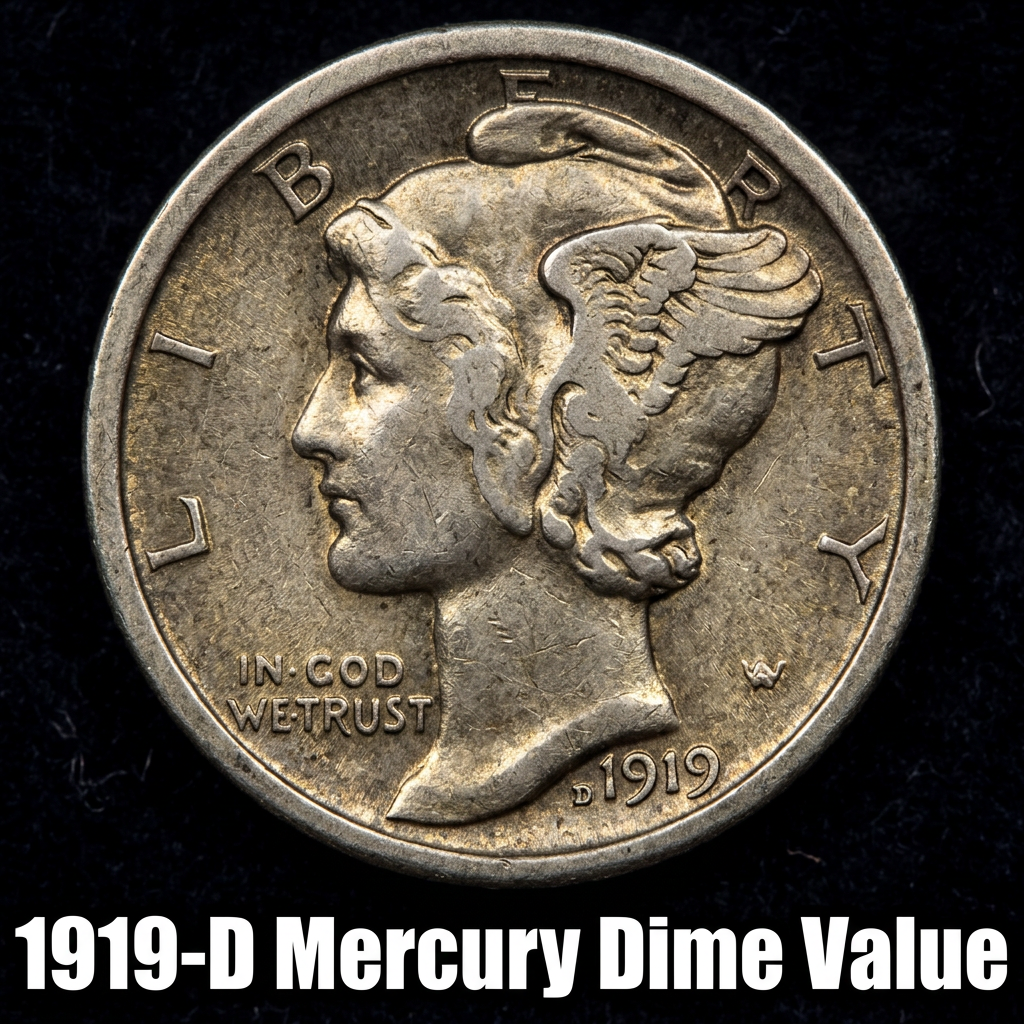
1919 D Mercury Dime Value and Price Guide for Collectors
The 1919-D Mercury Dime is worth anywhere from $5 in heavily worn condition to over $1,500 in high-grade mint state. Finding one of these silver treasures in a drawer or an old jar is an exciting moment for any American, as it represents a piece of early 20th-century history.
Determining the Rarity of Your 1919 Denver Mint Dime
When you hold a 1919-D Mercury Dime, you are looking at a coin struck at the Denver Mint over a century ago. During that year, the Denver facility minted approximately 9.9 million dimes, which sounds like a lot, but is actually much lower than the production numbers seen in Philadelphia. Because many of these coins circulated heavily during the post-WWI era, finding one today in “Extremely Fine” or “Uncirculated” condition is quite rare. If you are unsure exactly what you have, using a free coin identifier app can help you confirm the mint mark and basic design details in seconds.
Most casual collectors will find coins that are “Good” or “Very Good,” meaning the details are worn down. However, the 1919-D is a “key date” variant for many enthusiasts because it is harder to find in high grades compared to other years. The CoinKnow app is a fantastic tool for beginners to quickly see how these historical factors influence the current market price of their silver dimes without needing a professional numismatist right away.
Evaluating the Physical Condition and Grade
The value of your dime is almost entirely dependent on its grade. Professional graders look at the feathers in Lady Liberty’s cap and the diagonal lines on the “fasces” (the bundle of rods) on the reverse. If the lines on the fasces are clearly separated, the coin earns a “Full Bands” (FB) designation, which can skyrocket the price. Even a tiny bit of extra detail can mean a difference of hundreds of dollars.
To get an accurate estimate, you should compare your coin to known grading standards. For instance, the 1919-D Mercury Dime auction records show that coins in Mint State 65 or higher can sell for breathtaking amounts. If your coin looks shiny and brand new, even if it is over 100 years old, it is worth protecting in a plastic holder immediately to prevent any further scratches or oil transfer from your skin.
1919-D Mercury Dime Value Chart
The following table provides a breakdown of what you can expect to receive for a 1919-D Mercury Dime based on its condition. Please note that prices fluctuate based on silver spot prices and collector demand.
| Condition / Grade | Estimated Value (USD) |
|---|---|
| Good (G-4) | $5 – $8 |
| Fine (F-12) | $25 – $40 |
| Very Fine (VF-20) | $65 – $90 |
| Extremely Fine (EF-40) | $150 – $220 |
| Uncirculated (MS-60) | $450 – $600 |
| Choice Uncirculated (MS-65+) | $1,500+ |
Where to Find the Mint Mark and Why It Matters
Identifying the “D” mint mark is crucial because a 1919 dime without a mint mark (minted in Philadelphia) is much more common and generally worth less in circulated condition. On the Mercury Dime, the mint mark is located on the reverse side (the back), near the bottom left, just to the left of the base of the fasces. If you see a small ‘D’, your coin was struck in Denver. If you see an ‘S’, it’s from San Francisco.
Understanding the market worth of a 1919 Denver dime is easier when using modern digital tools. The CoinKnow app allows you to upload a photo and see instantly if that tiny letter ‘D’ is present. For many Americans, this small detail is the difference between a coin worth a few dollars in silver melt value and a rare collectible worth a significant portion of a mortgage payment.
Silver Content and Long-Term Value
Even if your 1919-D Mercury Dime is extremely worn and has no collector value, it still holds intrinsic value due to its metal content. Mercury Dimes were minted with 90% silver and 10% copper. This means that as the price of silver rises on the global market, the “floor” value of your coin rises as well. However, because the 1919-D is a scarcer date, it almost always sells for a premium above its “melt” price.
Collecting these coins is a great way to preserve wealth and history at the same time. Whether you use CoinKnow to manage your growing collection or just want to know the value of a single find, the 1919-D remains one of the more desirable coins in the “Winged Liberty Head” series. Always handle your coins by the edges and avoid cleaning them, as cleaning can actually strip away the value by damaging the original surface luster.
Frequently Asked Questions
Q: How can I tell if my 1919-D Mercury Dime is real?
A: Genuine 1919-D dimes should weigh approximately 2.5 grams and have a diameter of 17.9mm. Check the “D” mint mark under magnification to ensure it doesn’t look glued on. Using an app to compare it with high-resolution images of authentic coins is also recommended.
Q: Should I clean my old 1919 dime to make it worth more?
A: No! Never clean a collectible coin. Cleaning creates microscopic scratches that professional graders can easily spot, and it can reduce the coin’s value by 50% or more. Collectors prefer the natural “patina” or toning that comes with age.
Q: Is the 1919-D Mercury Dime the rarest in the series?
A: It is not the absolute rarest (that title belongs to the 1916-D), but the 1919-D is considered a “semi-key date,” especially in higher grades. It is significantly harder to find than the 1919 Philadelphia issue.
