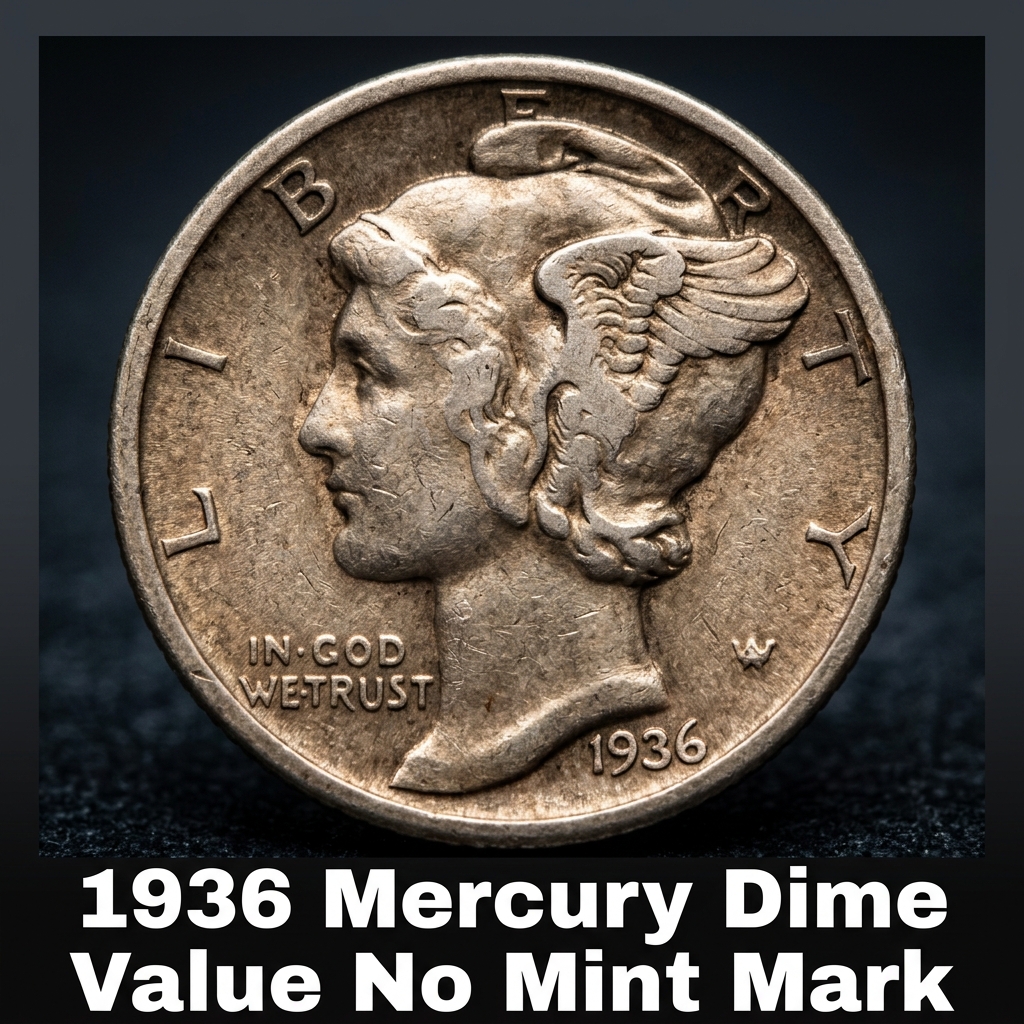
1936 Mercury Dime Value Without a Mint Mark and Collector Guide
The 1936 Mercury Dime is worth anywhere from $3 in heavily circulated condition to over $1,500 in high-grade mint state with Full Band details. This beautiful silver coin is a favorite among everyday Americans who enjoy checking their pocket change for hidden treasures from the Great Depression era.
Identifying the 1936 Mercury Dime No Mint Mark
Finding a 1936 Mercury Dime in an old jar or a drawer is an exciting moment for any casual collector. These coins are officially known as Winged Liberty Head dimes, designed by Adolph A. Weinman. To confirm you have the “no mint mark” version, you simply need to look at the reverse side of the coin. If there is no small letter “D” or “S” near the bottom left of the olive branch, your coin was struck at the Philadelphia Mint.
For those who aren’t sure if they are looking at a rare variety or just common damage, using a free coin identifier app can save you hours of manual research. While the Philadelphia Mint produced over 87 million of these dimes in 1936, the high silver content and historical significance keep the demand steady. If you want to get an instant valuation, the CoinKnow app is an excellent tool to help you distinguish between a common filler and a valuable investment grade piece.
Understanding the Current Market Value
The value of your 1936 Philadelphia dime depends almost entirely on its physical condition, also known as its “grade.” Because these coins were minted in 90% silver, they have an inherent “melt value” that acts as a price floor. Even if the coin is completely worn down, it will still be worth more than its face value of ten cents due to its precious metal content. However, the real money is found in coins that still show the fine details of Liberty’s hair and the feathers on her cap.
You can find a detailed breakdown of the 1936 Mercury Dime auction price trends to see how much collectors are currently paying for “Uncirculated” specimens. In general, if your coin looks like it just came from the bank—shiny and without scratches—it could be worth a significant premium over the silver price. Using CoinKnow allows you to see real-time market fluctuations so you don’t accidentally sell a high-value coin for cheap.
| Condition / Grade | Estimated Market Value |
|---|---|
| Good (G-4) | $3.00 – $4.50 |
| Fine (F-12) | $5.50 – $7.00 |
| Extremely Fine (XF-45) | $10.00 – $15.00 |
| Uncirculated (MS-60) | $25.00 – $35.00 |
| Mint State (MS-65+) | $60.00 – $1,500+ |
The Full Band Detail and Proof Strikes
When researching the 1936 no mint mark dime valuation, you will often see the term “Full Bands” or “FB.” This refers to the horizontal lines on the fasces (the bundle of sticks) on the back of the coin. If those lines are perfectly separated and not blended together, the coin is considered a masterpiece of striking and can sell for thousands of dollars at high-end auctions.
Additionally, 1936 was the first year the Mint resumed making Proof coins for collectors after a long hiatus. Only 4,130 Proof Mercury Dimes were struck in Philadelphia that year. These coins were never meant for circulation and feature a mirror-like finish. If you happen to find one of these in an old collection, you aren’t just looking at a few dollars; you are looking at a coin that can easily command $800 to over $3,000 depending on its preservation.
Factors That Influence Your Coins Worth
While the date and the lack of a mint mark tells half the story, the “eye appeal” is what drives the price for everyday Americans selling their finds. Scratches, holes, or signs that someone tried to clean the coin with chemicals will actually lower the value significantly. Serious collectors prefer original “toning,” which is a natural change in color that occurs as the silver reacts to oxygen over decades.
If you aren’t sure if your coin has been cleaned or if it’s a rare error, the CoinKnow app can help by comparing your coin’s image to known high-grade examples. Avoid the temptation to scrub your coin with polish; even a soft cloth can leave micro-scratches that a professional grader will spot instantly. Keep your 1936 Mercury Dime in a protective sleeve or a flip to preserve its current state and its future resale value.
Q: Is a 1936 dime with no mint mark rare?
A: It is not rare in circulated condition, as over 87 million were made. However, it is very rare and valuable in high “Mint State” grades or if it is a Proof strike.
Q: How much silver is in a 1936 Mercury Dime?
A: These coins are made of 90% silver and 10% copper. They contain approximately 0.07234 ounces of pure silver, giving them a base value that rises with the price of silver bullion.
Q: Where is the mint mark located on a 1936 dime?
A: On Mercury Dimes, the mint mark (if there is one) is located on the reverse side, at the bottom left, just to the left of the base of the olive branch. If that space is blank, it was minted in Philadelphia.
