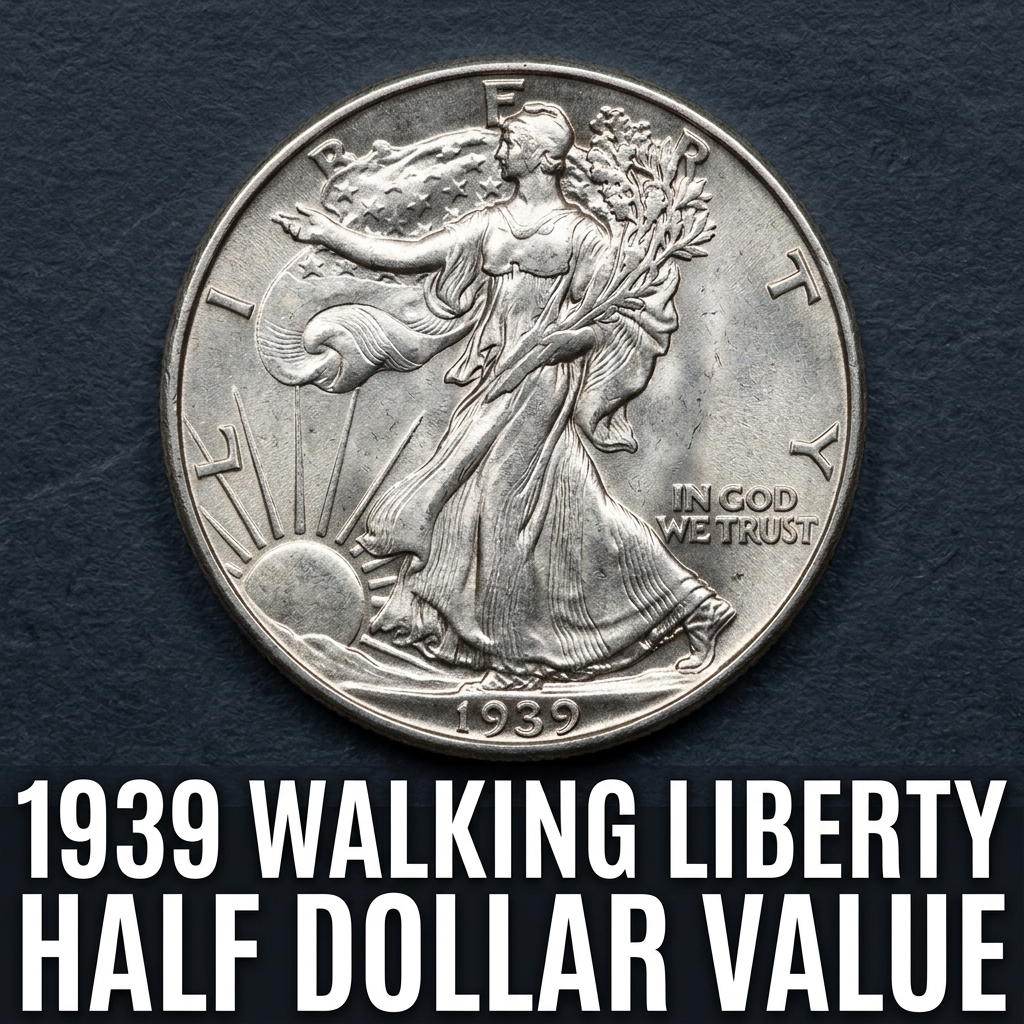
1939 Walking Liberty Half Dollar Value and Price Guide for Collectors
The 1939 Walking Liberty Half Dollar is worth anywhere from $12 in worn condition to over $150 in mint state. Finding one of these beautiful silver coins in your pocket change or an old jar is an exciting discovery, as they represent a high point in American numismatic design and carry significant precious metal value.
Understanding the 1939 Walking Liberty Half Dollar History
The 1939 Walking Liberty Half Dollar is part of a series often cited as the most beautiful silver coin ever minted by the United States. Designed by Adolph A. Weinman, it features Lady Liberty striding toward the sun, draped in the American flag. By 1939, the United States was slowly emerging from the Great Depression, and these coins circulated heavily in daily commerce. If you are unsure about a coin you’ve found, using a free coin identifier app can help you confirm the date and mint mark instantly.
While millions were minted, many were lost to the melting pots during times of high silver prices or simply worn down until the details vanished. For everyday Americans, finding one today is like holding a piece of 1930s history. To get a professional-grade assessment of your collection from home, many people now turn to the CoinKnow app to organize their finds.
How Much is a 1939 Half Dollar Worth Today
The value of your 1939 half dollar depends heavily on two factors: its silver content and its preservation. Every 1939 half dollar is composed of 90% silver, giving it an intrinsic “melt value” that fluctuates with the market. However, for collectors, the numismatic premium often far exceeds the silver price. Most circulated coins found in “Good” or “Very Good” condition will trade for their silver weight plus a small premium.
As the condition improves to “Extremely Fine” or “Uncirculated,” the price climbs significantly. High-grade specimens are particularly sought after by registry set collectors. You can find detailed breakdowns of the 1939 walking liberty half dollar auction records and mint state prices to see just how high these values can go for perfectly preserved coins.
| Condition | 1939 (Philadelphia) | 1939-D (Denver) | 1939-S (San Francisco) |
|---|---|---|---|
| Good / Very Good | $12 – $14 | $12 – $15 | $12 – $15 |
| Fine / Very Fine | $16 – $22 | $18 – $25 | $18 – $25 |
| Extremely Fine | $30 – $40 | $45 – $60 | $40 – $55 |
| Uncirculated (MS63+) | $75 – $500+ | $120 – $800+ | $150 – $1,200+ |
Identifying Mint Marks and Varieties
In 1939, three different mints produced these half dollars: Philadelphia, Denver, and San Francisco. The Philadelphia mint coins have no mint mark. For the Denver (D) and San Francisco (S) versions, you can find the mint mark on the reverse side of the coin. Look at the lower-left area near the rim, just below the eagle’s branch.
Generally, the 1939-D and 1939-S carry a slight premium over the Philadelphia issues because of their lower mintage numbers. When checking your 1939 silver half dollar value by mint mark, pay close attention to the small “D” or “S” as it can double the price in higher grades. Tools like CoinKnow make it easy to zoom in on these small details through your smartphone camera.
Grading Your 1939 Walking Liberty Coin
Determining the grade of your coin is the most important step in valuation. A coin in “Good” condition will show a clear date and outline of Lady Liberty, but most of her gown details and the eagle’s feathers will be worn flat. In “About Uncirculated” or “Mint State” condition, you should see original mint luster—that satiny shine typical of a new coin—and full details on the eagle’s breast.
Because silver is a soft metal, these coins wore down quickly. If your 1939 half dollar still has sharp lines on the sun’s rays or distinct feathers on the eagle’s wing, you may have a valuable treasure. To ensure you aren’t missing out on a rare variety or a high-grade specimen, using the CoinKnow app can provide you with a baseline grade and current market estimates.
Q: Where is the mint mark on a 1939 Walking Liberty Half Dollar?
A: The mint mark is located on the reverse (back) of the coin. Look for a small “D” or “S” on the lower-left side, near the rim, tucked under the branch the eagle is perched on. If there is no letter, it was minted in Philadelphia.
Q: Is a 1939 half dollar made of real silver?
A: Yes, all Walking Liberty Half Dollars minted in 1939 are composed of 90% silver and 10% copper. Each coin contains approximately 0.3617 ounces of pure silver.
Q: Should I clean my 1939 half dollar to make it worth more?
A: No, you should never clean old coins. Cleaning removes the original surface (patina) and creates micro-scratches that significantly reduce the numismatic value. Collectors prefer “dirty” original coins over cleaned ones.
