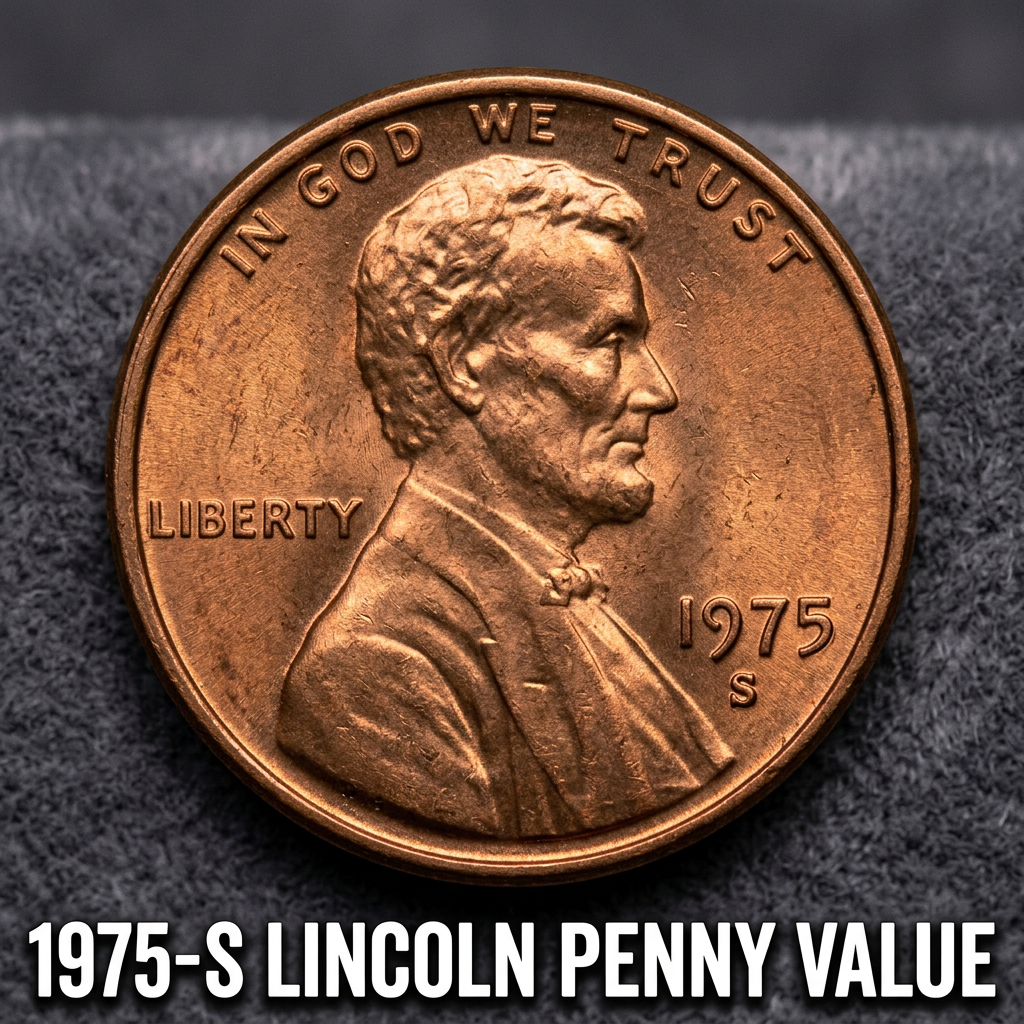
1975 S Lincoln Penny Value Guide for Collectors and Pocket Change Hunters
The 1975-S Lincoln Penny is worth anywhere from its face value of $0.01 in circulated condition to over $1,500 for high-grade proof specimens. If you have found one of these copper coins in your jar, it is important to understand its unique history and minting process to determine its true market price.
How Much is a 1975-S Proof Penny Worth Today
Many people search through their change hoping to find a 1975-S penny, but there is an important detail to remember: San Francisco did not produce business-strike pennies for general circulation in 1975. All pennies with the “S” mint mark from this year were struck as Proof coins, specifically intended for collectors. If you have one of these, it likely came out of a United States Proof Set. To get an instant valuation of your specific coin, you can use a free coin identifier app to check its condition and rarity.
The value of a 1975-S Lincoln Penny is largely determined by its visual appeal and grade. Most standard proof versions sell for between $1 and $5. However, if the coin has a “Deep Cameo” (DCAM) finish—meaning the portrait of Lincoln is frosty and the background is mirror-like—the price can jump significantly. Professional grading is often necessary for the highest-value pieces, and using the CoinKnow app can help you decide if your coin is worth the grading fee.
Comparing 1975 Penny Values by Condition and Mint Mark
While the 1975-S is the most sought-after by proof collectors, millions of pennies were also struck in Philadelphia (no mint mark) and Denver (D). Knowing the difference is key to understanding what you have in your hand. The 1975-S stands out because of its polished finish, whereas the 1975 and 1975-D pennies look like standard pocket change.
For those looking for detailed market data, you can view the latest 1975 Lincoln Penny price charts to see how much collectors are paying for Red (RD) gem-quality coins. Generally, unless a 1975 penny is in pristine, uncirculated condition, it is only worth its weight in copper (about 2 to 3 cents).
| Condition / Grade | 1975 (No Mint Mark) | 1975-D Value | 1975-S Proof Value |
|---|---|---|---|
| Circulated (Average) | $0.01 – $0.05 | $0.01 – $0.05 | N/A (Proof Only) |
| Uncirculated (MS-65) | $1.00 – $3.00 | $1.00 – $4.00 | $3.00 – $7.00 |
| Deep Cameo (PR-69) | N/A | N/A | $15.00 – $40.00 |
| Auction Record | $9,000+ (MS-68) | $1,100+ (MS-67) | $1,500+ (PR-70) |
What Makes a 1975-S Penny Rare or Valuable
The rarity of a 1975-S penny isn’t based on the mintage numbers—over 2.8 million were struck—but rather on the state of preservation. Because these were made for sets, many were handled with care. However, finding a “Perfect 70” graded coin is extremely difficult. Most 1975-S pennies found in the wild today have been removed from their cases and might show fingerprints or hair-thin scratches, which lowers the value significantly.
If you are curious about current 1975 Lincoln Penny market trends, you will see that collectors are currently paying premiums for coins with zero imperfections. This is why tools like CoinKnow are so popular among hobbyists; they allow you to take a clear photo of your coin and identify minute details that the naked eye might miss.
Key Errors to Look for on 1975 Lincoln Pennies
While standard 1975-S pennies have a set market value, error coins are the “wild cards” that can be worth hundreds of dollars. Errors occur during the minting process and include things like “Double Dies,” “Off-Center Strikes,” or “Repunched Mint Marks.” For the 1975 series, keep an eye out for doubling on the letters of “LIBERTY” or the date.
Even a common 1975-D penny can become a valuable treasure if it was struck on a different metal blank by mistake. While rare, these “wrong planchet” errors are the holy grail for change hunters. Utilizing the CoinKnow platform can provide you with a database of known errors so you can compare your find to documented rarities.
Q: Is a 1975-S penny made of real copper?
A: Yes, all pennies struck in 1975, including the “S” mint mark proof coins, are composed of 95% copper and 5% zinc. It wasn’t until mid-1982 that the U.S. Mint switched to copper-plated zinc.
Q: Why can’t I find a 1975-S penny in my pocket change?
A: Since the 1975-S was only produced as a Proof coin for collectors, it was never intended to circulate. If you find one in change, it means someone broke open a Proof Set and spent the coin as a regular cent.
Q: Is it worth getting my 1975-S penny professionally graded?
A: Generally, it is only worth grading if the coin appears to be in perfect, flawless condition (PR-69 or PR-70). The cost of professional grading (around $30-$50) often exceeds the value of a lower-grade proof coin.
