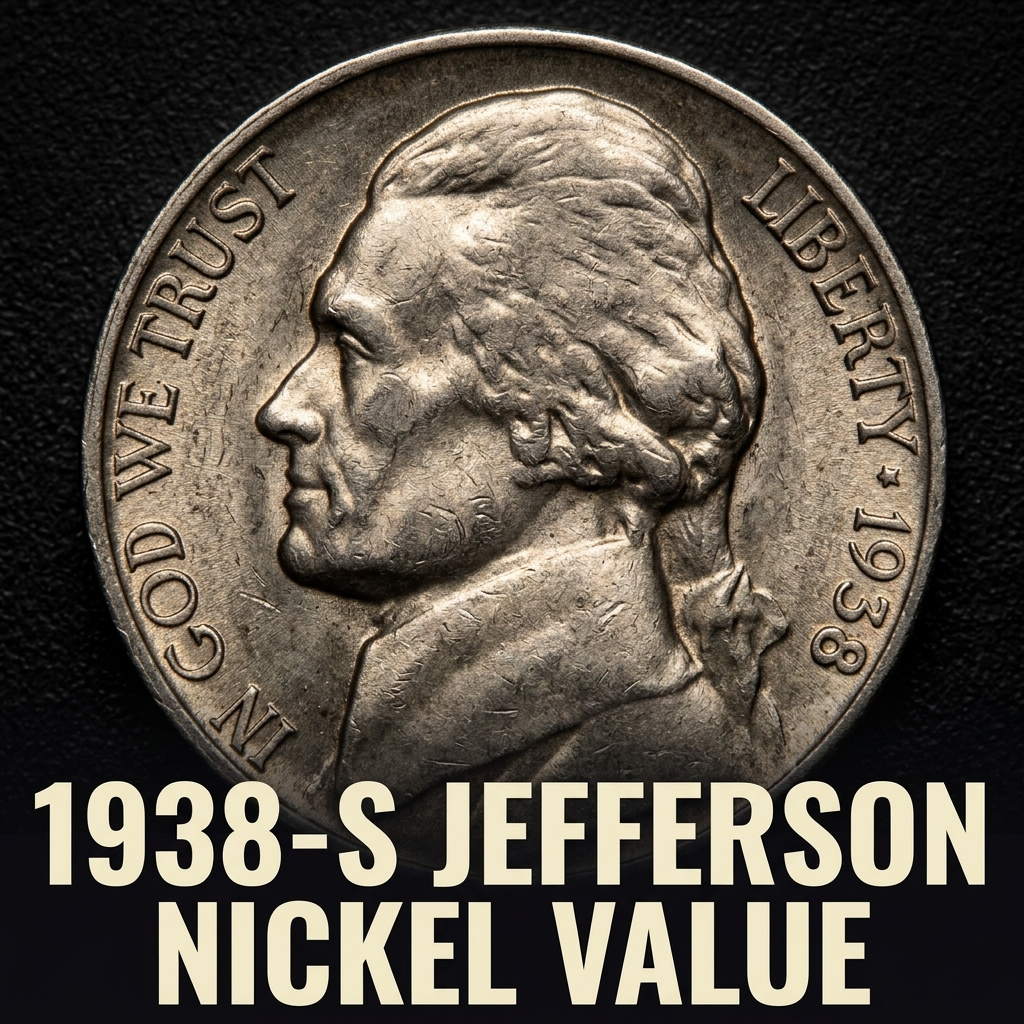
How Much is a 1938-S Jefferson Nickel Worth Today
The 1938-S Jefferson Nickel is worth anywhere from $2 in worn condition to over $100 in high-grade mint state. This San Francisco minted coin is a favorite among collectors because it represents the very first year the Jefferson design replaced the iconic Buffalo Nickel, making it a historic piece of American pocket change.
History and Significance of the 1938 San Francisco Mint Nickel
The year 1938 was a major turning point for the United States five-cent piece. For twenty-five years, the Buffalo Nickel had reigned supreme, but the Treasury Department decided it was time for a change. They held an open competition to find a portrait of Thomas Jefferson and a depiction of his home, Monticello. Felix Schlag won the $1,000 prize, and production began late in the year.
The San Francisco Mint (marked with an “S”) produced the lowest number of nickels that year compared to Philadelphia and Denver. Only 4,105,000 of these coins were struck in California. Because this was the inaugural year, many people realized they might be valuable and saved them. If you aren’t sure if you have a genuine 1938-S or a common variety, using a free coin identifier app can help you verify the mint mark and condition instantly.
When looking at your coin, check the reverse side. The “S” mint mark is located to the right of Monticello, between the building and the rim. Finding this small letter is the first step in confirming you have a coin that is worth significantly more than its five-cent face value. For a quick assessment on the go, the CoinKnow app provides real-time identification for beginners.
Determining the Condition and Grade of Your 1938-S Nickel
In the world of coin collecting, condition is everything. A 1938-S nickel that has spent decades rattling around in pockets will look dull and smoothed out. These “circulated” coins are still worth more than five cents because of their age and low mintage, but the real money lies in “Uncirculated” or “Mint State” examples. Collectors look for sharp details on Jefferson’s hair and the pillars of Monticello.
To get an accurate sense of what your coin might sell for at auction, you can check the latest 1938-S Jefferson Nickel price guide for professional grading standards. Most 1938-S nickels found in old jars today fall into the “Fine” or “Very Fine” categories. However, if your coin still has its original “cartwheel” luster and no scratches, it could be a high-value specimen.
Using a tool like CoinKnow allows you to compare your coin against high-resolution images of graded pieces. This helps you decide if it is worth paying for a professional grading service like PCGS or NGC. Remember, even a small difference in wear on the steps of Monticello can mean a difference of twenty or thirty dollars in the final market price.
Current Market Value and Price Reference Table
Because only 4 million were made, the 1938-S is considered a “semi-key date” for the Jefferson series. While it isn’t as rare as some 19th-century coins, it is much harder to find than nickels from the 1940s or 50s. The value has remained steady over the years because every collector building a Jefferson Nickel set needs this specific coin to complete the first page of their album.
The 1938 Jefferson Nickel value information shows that prices jump significantly once you reach the MS65 grade. Below is a breakdown of what you can expect to receive for a 1938-S nickel based on its physical condition.
| Condition / Grade | Estimated Value |
|---|---|
| Good (G-4) to Fine (F-12) | $2.00 – $3.50 |
| Extremely Fine (XF-40) | $5.00 – $8.00 |
| About Uncirculated (AU-50) | $10.00 – $15.00 |
| Mint State (MS-63) | $25.00 – $35.00 |
| Gem Mint State (MS-65+) | $60.00 – $150.00+ |
| Full Steps (FS) Designation | $200.00 – $1,500.00 |
Rare Varieties and the Full Steps Designation
If you want to find the “holy grail” of 1938-S nickels, you need to look at the steps of Monticello on the back of the coin. Most nickels from this era have blurry or merged steps due to weak strikes. If your coin has five or six clearly defined, horizontal steps without any interruptions or scratches, it receives the “Full Steps” (FS) designation. A 1938-S with Full Steps is exceptionally rare and can sell for over $1,000 at a high-end auction.
There are also interesting mint mark varieties to look for. Some coins show a “Large S” while others have a “Small S,” and there are even rare “Re-punched Mint Mark” (RPM) errors where the “S” looks like it was stamped twice. These errors are hard to see with the naked eye, but the CoinKnow magnification features make it much easier to spot these profitable mistakes.
Whether you found one in a roll from the bank or inherited a small collection, the 1938-S is a piece of history worth holding onto. While most won’t make you rich, finding a coin that is worth 40 to 100 times its face value is always an exciting discovery for any American.
Q: Where is the mint mark on a 1938-S Jefferson nickel?
A: The “S” mint mark is located on the reverse (back) of the coin. Look to the right of the Monticello building, in the space between the building and the rim of the coin.
Q: Is a 1938-S nickel made of silver?
A: No, the 1938-S Jefferson Nickel is made of 75% copper and 25% nickel. Silver was only used in nickels from 1942 to 1945 during World War II (known as War Nickels).
Q: How many 1938-S nickels were made?
A: The San Francisco Mint produced 4,105,000 nickels in 1938, which is the lowest mintage of the three mints that produced the coin that year.
