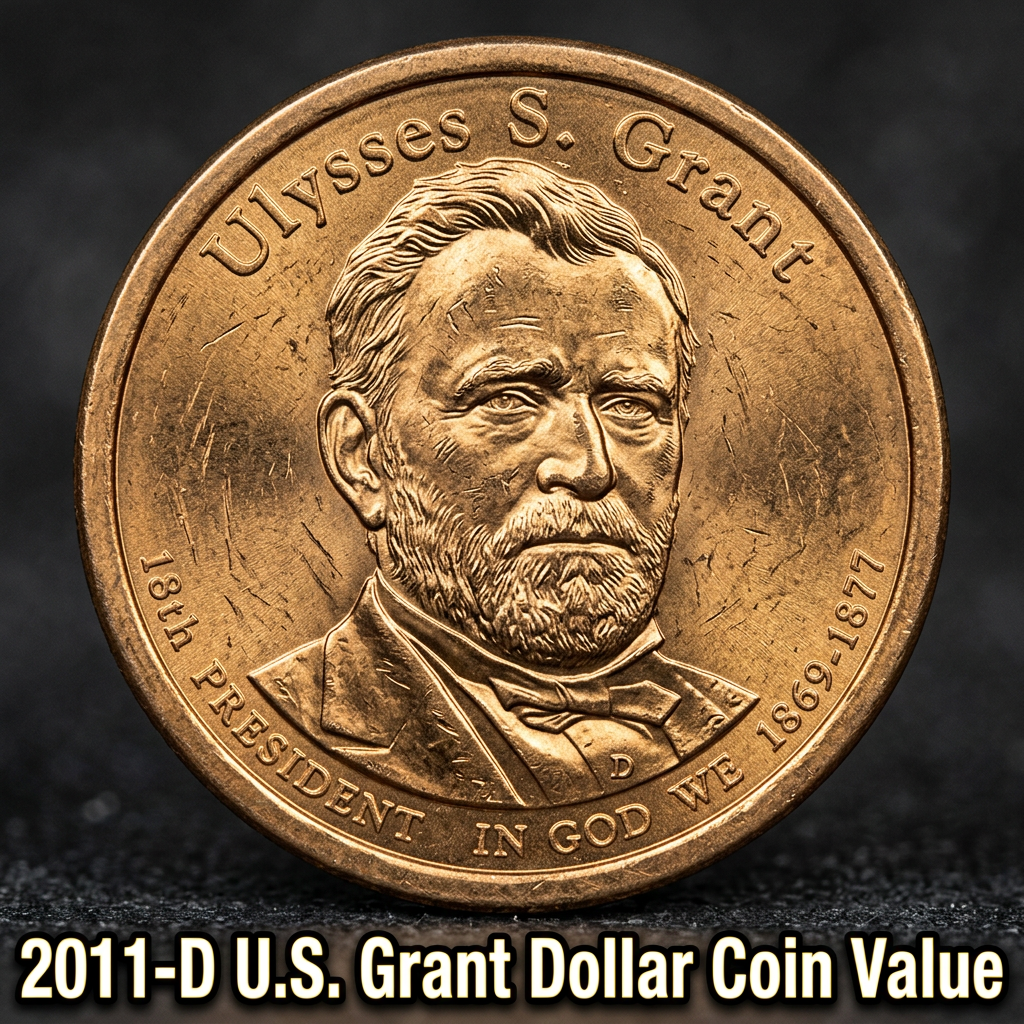
How Much Is a 2011 D Ulysses S Grant Presidential Dollar Worth Today
The 2011 D Ulysses S Grant Dollar is worth anywhere from $1.25 in circulated condition to over $45 in high-grade mint state. Most of these golden-colored coins you find in your pocket change or old jars are common, but certain rare specimens and strike qualities can command a higher premium among collectors.
Understanding the 2011 D Ulysses S Grant Coin History
The Ulysses S. Grant dollar is part of the United States Mint’s Presidential $1 Coin Program, which honored the nation’s former leaders in the order they served. Released in 2011, this specific coin features the 18th President of the United States on the obverse. While these coins have a distinct golden color, they do not actually contain any real gold. They are composed of a copper core with a manganese brass cladding, which gives them that “gold-like” shine when they are brand new.
If you have stumbled upon one of these coins while cleaning out your house, you might be wondering if it is a rare treasure. To get a definitive answer quickly, you can use a free coin identifier app to scan your coin and see exactly what version you have. The “D” mint mark on this coin indicates it was produced at the Denver Mint, which struck over 37 million of these pieces. Using the CoinKnow app can help you distinguish between the Denver and Philadelphia versions in seconds.
Because 2011 marked the final year that Presidential Dollars were minted for general circulation, later years became much rarer. However, the Grant dollar was still produced in significant numbers. Most people who find these today see them as interesting collectibles rather than major investments, though finding one in perfect, uncirculated condition can bring a nice surprise to your wallet.
Determining the Market Value of Grant Presidential Dollars
When looking at the value of your 2011 D Grant dollar, the single most important factor is the condition, or “grade,” of the coin. Most coins found in circulation—meaning they have been spent at stores or handled by many hands—are only worth their face value of $1 to a bank. However, collectors will often pay a small premium for coins that still have their original mint luster.
For those looking for specific pricing data, the 2011 Presidential Dollar price guides show that coins in MS65 condition (Mint State) typically sell for about $5 to $8. If you happen to find a coin that looks absolutely flawless with no scratches visible to the naked eye, it could be worth significantly more. Professional grading can often reveal hidden value in seemingly common coins.
It is also worth noting that the “D” mint mark is located on the edge of the coin, not the face. This is called edge-incused lettering. If you find a Grant dollar with a smooth edge that is missing the date and mint mark, you have found a major error coin. These “plain edge” errors are highly sought after and can be worth hundreds of dollars, though they are quite rare for the 2011 series. Using CoinKnow allows you to compare your coin against known error databases easily.
| Condition Grade | Estimated Market Value |
|---|---|
| Circulated (F-VF) | $1.00 – $1.25 |
| Uncirculated (MS60) | $2.00 – $3.50 |
| Choice Uncirculated (MS65) | $6.00 – $12.00 |
| Gem Uncirculated (MS67+) | $45.00+ |
Key Features and Variations of the 2011 D Grant Coin
One of the most unique aspects of the 2011 D Ulysses S. Grant coin is the edge lettering. Unlike traditional coins where the date and mint mark are on the front or back, these details are engraved along the thin side of the dollar. This includes the year “2011,” the “D” mint mark, and the motto “E Pluribus Unum.” Because this was done in a separate step during manufacturing, it created opportunities for interesting variations in how the text is oriented.
Collectors often look for “Position A” or “Position B” edge lettering. This simply refers to whether the lettering is right-side up or upside-down when the President’s portrait is facing up. In the current market, neither position carries a significant price premium, but it is a fun detail for hobbyists to track. For more detailed 2011 D Ulysses S Grant value insights, checking auction records for high-grade specimens is the best way to see what buyers are actually paying.
If your coin has a “P” instead of a “D,” it was minted in Philadelphia. Generally, the values are very similar between the two mints for this year. However, always keep an eye out for “Proof” versions, which have a mirror-like finish and were only sold in special sets from the Mint. While your average pocket change find won’t be a proof, the CoinKnow app can help you identify the visual differences between a standard business strike and a proof strike.
Frequently Asked Questions about 2011 D Grant Dollars
Q: Is the 2011 D Ulysses S Grant dollar made of real gold?
A: No, despite its golden appearance, it contains zero gold. It is made of a mixture of copper, zinc, manganese, and nickel. The “gold” color comes from the manganese brass outer layer.
Q: Where can I find the mint mark on my 2011 Grant dollar?
A: You won’t find the mint mark on the front or back of the coin. You must look at the edge (the side) of the coin. You will see the date 2011 followed by a “D” for Denver or a “P” for Philadelphia.
Q: Should I spend my 2011 D Grant dollar or save it?
A: If the coin is heavily scratched or worn from being in circulation, it is likely only worth $1 and is safe to spend. If it looks brand new and shiny as if it just came from the mint, you should keep it in a protective sleeve as its value may increase over time.
