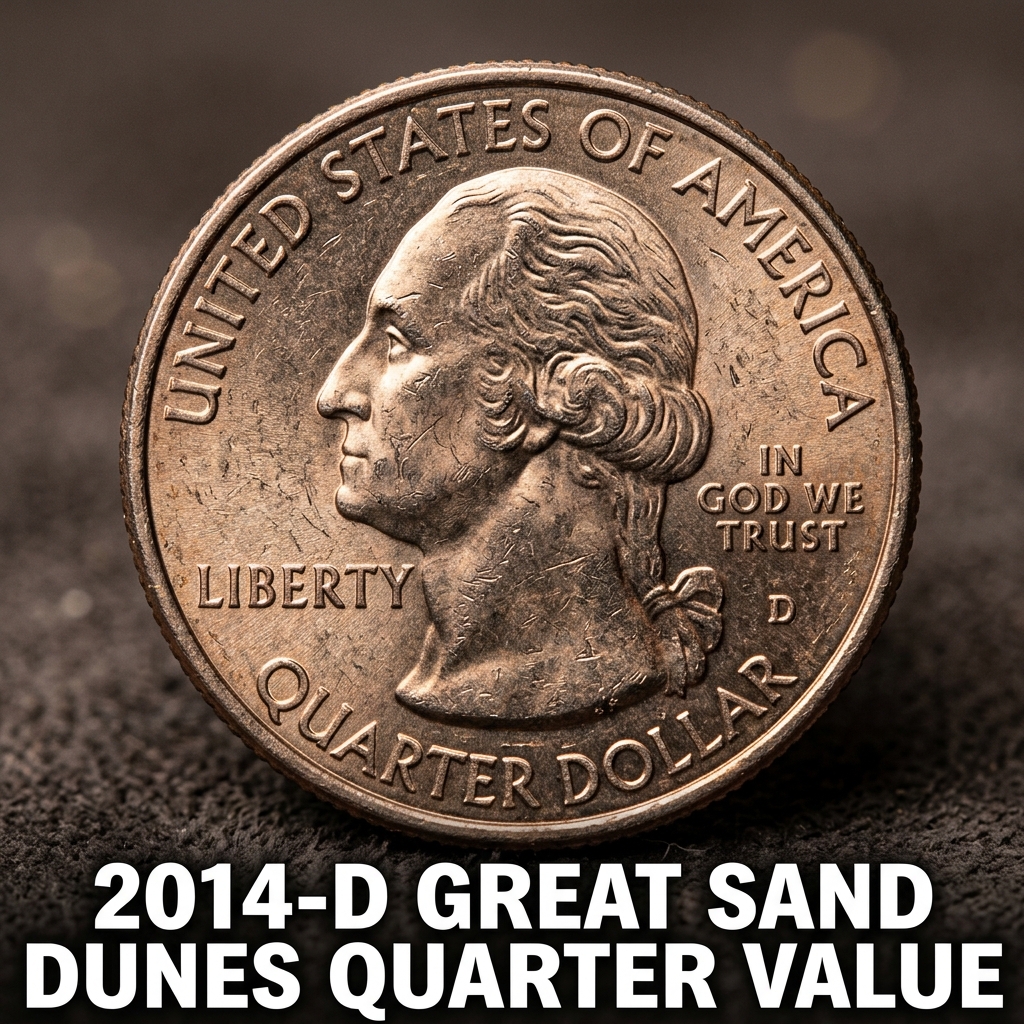
How Much Is My 2014 D Great Sand Dunes Quarter Worth Today
The 2014 D Great Sand Dunes Quarter is worth anywhere from its $0.25 face value in worn condition to over $15 for high-grade uncirculated specimens. If you have found one of these beautiful coins in your pocket change, you are likely looking at a beautiful piece of Colorado history that holds significant interest for modern collectors.
Understanding the History of the 2014 D Great Sand Dunes Quarter
The Great Sand Dunes National Park quarter was released in 2014 as part of the United States Mint’s “America the Beautiful” series. This particular coin represents the state of Colorado and features a stunning design of a father and son playing in the sand next to the massive dunes, with the Sangre de Cristo Mountains towering in the background. The “D” mint mark indicates that this coin was produced at the Denver Mint.
If you are unsure about whether your coin is a Denver mint or another variety, using a free coin identifier app can help you zoom in on the mint mark located on the obverse side. For many casual hunters, the CoinKnow app is a favorite tool because it identifies these modern quarters instantly. While these coins were minted in millions, finding one in pristine, “mint” condition is what actually drives the value up for serious collectors.
The Current Market Value for 2014 D Quarters
Most 2014 D Great Sand Dunes quarters you find in daily circulation are only worth twenty-five cents. Because over 150 million of these were struck in Denver alone, they are not considered “rare” in the traditional sense. However, the story changes drastically when we look at coins that have never been handled by the public. Collectors look for “Mint State” (MS) grades, which are coins that look exactly like they did the day they left the press.
Higher-grade examples, such as those graded MS67 or MS68 by professional services, can sell for much higher premiums. You can track current market trends and see specific Great Sand Dunes quarter auction records to see what the highest sales have been recently. For the average American, keeping an eye out for a shiny, scratch-free quarter is the best way to find a coin worth more than its face value.
| Condition / Grade | Approximate Market Value |
|---|---|
| Circulated (Average Pocket Change) | $0.25 |
| About Uncirculated (AU) | $0.50 – $0.85 |
| Uncirculated (MS63 – MS65) | $1.00 – $5.00 |
| Choice Uncirculated (MS67+) | $15.00 – $45.00+ |
Key Characteristics of the Great Sand Dunes National Park Quarter
The reverse design of this coin was created by Don Everhart and is one of the more detailed entries in the ATB series. When examining your 2014 D quarter, look at the sharpness of the sand dunes and the clarity of the figures. In high-grade coins, the texture of the sand should be visible without any “bag marks” (small nicks or scratches caused by coins hitting each other during production).
To get a better sense of how your coin stacks up against others from the same year, researching comprehensive 2014 quarter price lists can provide useful benchmarks. Often, if your coin looks “frosty” or has a mirror-like finish, it might be a special strike. Using the CoinKnow app can help you distinguish between a standard business strike and coins that might have been part of a special set.
Searching for Errors and Varieties on 2014 D Quarters
While no massive “game-changing” errors have been widely reported for the 2014 D Great Sand Dunes Quarter, collectors always look for minor imperfections that can boost value. These include “Doubled Die” errors, where parts of the design appear to have a shadow or a double image, or “Die Chips,” where a small piece of the metal die broke off and left a raised blob of metal on the coin’s surface.
Error hunting is a popular pastime for many Americans because an error coin can be worth ten to twenty times what a normal coin would be. If you notice something “weird” about your quarter—like a part of the mountain looking distorted or words having an extra thickness—always set it aside. The CoinKnow community often discusses these minor finds, which can help you decide if it’s worth sending in for professional grading.
Q: Is the 2014 D Great Sand Dunes quarter made of silver?
A: No, the 2014 D quarters found in circulation are composed of a copper-nickel clad “sandwich.” Only special San Francisco (S) mint Proof quarters were sometimes minted in 90% silver for collectors.
Q: Where can I find the mint mark on my 2014 quarter?
A: The mint mark is located on the front (obverse) of the coin, to the right of George Washington’s ponytail. A “D” stands for Denver, while a “P” stands for Philadelphia.
Q: Why is my 2014 D quarter only worth 25 cents?
A: Because the Denver Mint produced over 151 million of these coins, they are very common. Only those in exceptional uncirculated condition or those with rare errors carry a premium value.
