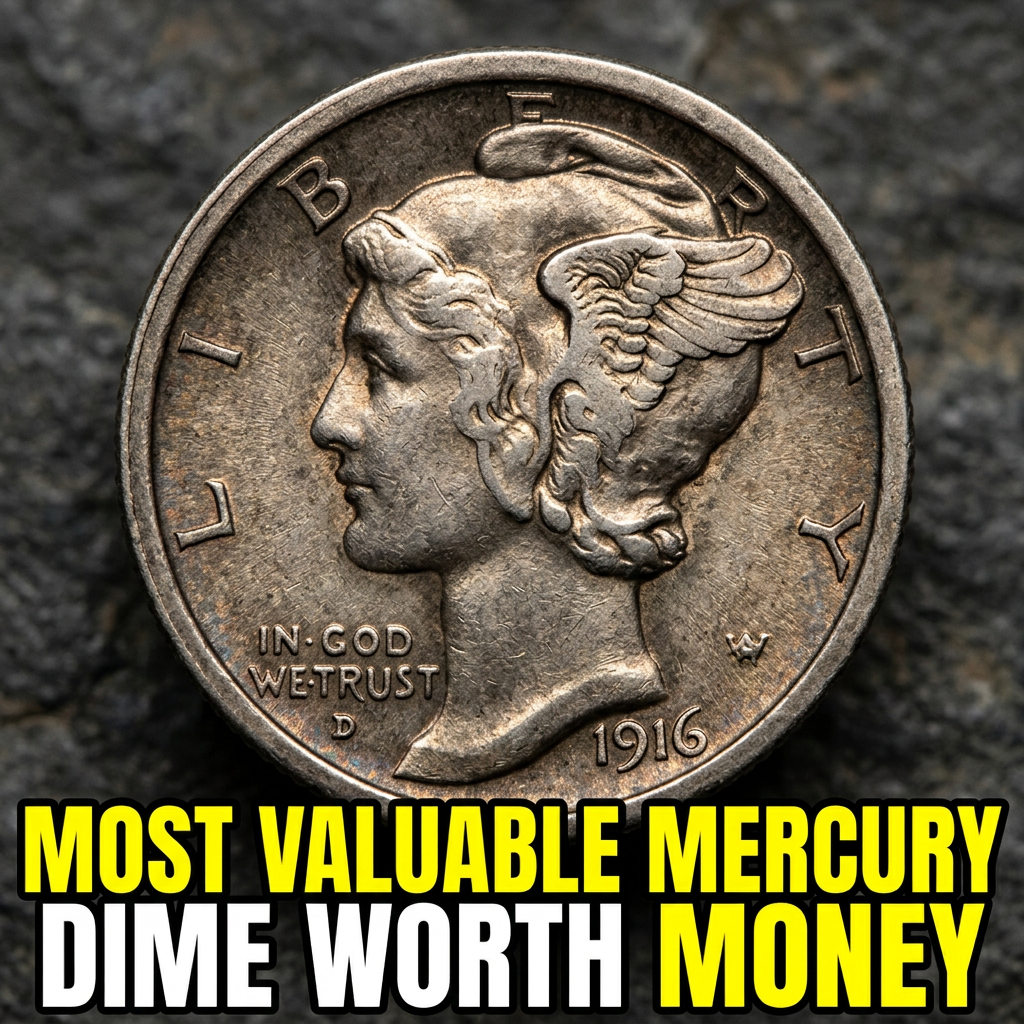
The Most Valuable Mercury Dimes You Might Find in Your Pocket Change
The Mercury Dime is worth anywhere from $2 in heavily circulated condition to over $100,000 for rare mint state specimens. These beautiful silver coins, officially known as the Winged Liberty Head, are a favorite among collectors and everyday Americans who dream of finding a hidden treasure in an old jar.
The Legendary 1916 D Mercury Dime Key Date
The undisputed king of this series is the 1916-D Mercury Dime. Only 264,000 of these examples were minted in Denver, making them incredibly rare compared to the millions produced in Philadelphia. If you find a 1916 dime with a small “D” on the reverse, you have found a small fortune.
Even in poor condition, this specific date is highly sought after by collectors. To ensure you are accurately identifying your finds, using a free coin identifier app can help you distinguish between a common mintage and a rare key date. Most people rely on the CoinKnow app to get instant feedback on their silver coins.
Because of its high value, the 1916-D is often counterfeited. Professional grading is almost always required to verify its authenticity. This coin is the ultimate “holy grail” for collectors, often serving as the final piece needed to complete a full set of Mercury Dimes.
The Rare Overdate Errors of 1942
Another fascinating group of valuable dimes involves the 1942/1 and 1942/1-D overdate errors. These occurred when a 1941 hub was accidentally impressed with a 1942 die, resulting in a visible “1” underneath the “2” in the date. These errors are prominent enough to be seen with a simple magnifying glass.
These error coins are worth hundreds or even thousands of dollars depending on how much wear they have. The Philadelphia version is quite rare, but the Denver mint version is even harder to find in high grades. If you aren’t sure if your 1942 dime has this error, you can check the 1916-D Mercury Dime current market rates and other high-value prices to see how your coin compares.
Many people use the CoinKnow app to scan their 1942 dimes for these micro-details. Finding an error like this is like winning a mini-lottery, as these coins often trade for much more than their silver weight or face value.
| Year & Mint Mark | Approximate Value (Circulated) | Approximate Value (Mint State) |
|---|---|---|
| 1916-D | $1,000 – $3,500 | $15,000 – $100,000+ |
| 1921-P or 1921-D | $50 – $150 | $1,000 – $3,000 |
| 1942/1 Overdate | $400 – $650 | $2,000 – $15,000 |
| Common Date Silver | $2.00 (Melt Value) | $5.00 – $20.00 |
Condition and Full Bands Designations
When determining the value of your silver dimes, the condition is the most important factor after the date and mint mark. Collectors pay a massive premium for coins with “Full Bands” (FB). This refers to the horizontal lines on the fasces (the bundle of sticks) on the back of the coin.
If these bands are fully separated and distinct, the coin was struck exceptionally well. A common date Mercury Dime might be worth $10 in high grade, but if it has the Full Bands designation, that price can jump to hundreds of dollars. You can browse various Mercury Dime price guides and values to see the drastic difference condition makes.
Before selling your coins, it is wise to use CoinKnow to understand the potential grade of your collection. Even “common” silver dimes minted during the 1940s can be valuable if they look like they just came from the mint yesterday.
Finding and Identifying Valuable Silver Dimes
Most Mercury Dimes you find will be common dates from the late 1930s and 1940s. These are composed of 90% silver, meaning they are always worth at least their weight in precious metals. As the price of silver fluctuates, even the most worn-out dime becomes a small investment.
Keep an eye out for the 1921 and 1921-D dimes as well. These are considered “semi-key” dates and are much rarer than the later issues. Because the economy was in a recession in 1921, very few dimes were produced, leading to a natural scarcity that drives prices up today for lucky finders.
Always look at the reverse side of the coin, to the left of the base of the fasces. If you see a “D” for Denver or an “S” for San Francisco, you should look up that specific year. Coins with no mint mark were made in Philadelphia and are generally more common, with the exception of error varieties.
Q: How can I tell if my Mercury Dime is silver?
A: Every Mercury Dime minted between 1916 and 1945 is made of 90% silver. If you look at the edge of the coin and don’t see a copper stripe, and the coin has a distinct “ring” when tapped, it is silver.
Q: Where is the mint mark located on a Mercury Dime?
A: The mint mark is found on the reverse (back) of the coin. It is a tiny letter located at the bottom, just to the left of the base of the torch/fasces.
Q: Is it worth getting my Mercury Dime graded?
A: It is only worth the cost of professional grading if you believe you have a rare date like the 1916-D, an overdate error, or a coin in “uncirculated” condition with Full Bands. Most common circulated dimes are worth their silver value and don’t require grading.
