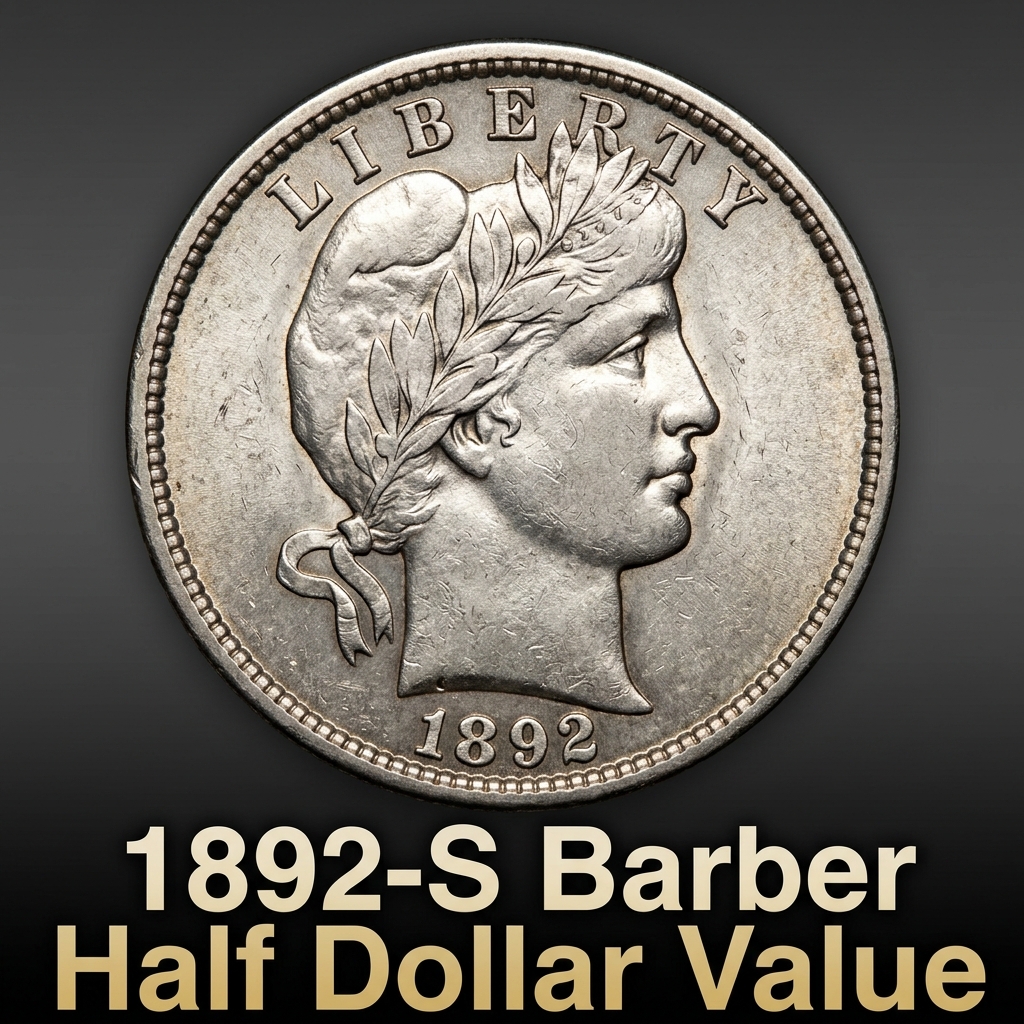
Value of the 1892-S Barber Half Dollar and Grading Guide
The 1892-S Barber Half Dollar is worth anywhere from $450 in heavily worn condition to over $30,000 for high-grade mint state specimens. As one of the rarest semi-key dates in the entire series, finding this silver coin in your collection often means you have discovered a valuable piece of American history.
What Makes the 1892-S Barber Half Dollar Special
The year 1892 marked the very first year of the Barber design, named after its creator, Chief Engraver Charles E. Barber. While the Philadelphia mint produced nearly a million copies, the San Francisco mint struck only 396,504 coins. This relatively low mintage, combined with the fact that these coins circulated heavily in the frontier economy of the West, makes the 1892-S incredibly difficult to find today.
If you have stumbled upon an old silver coin and aren’t sure what you are looking at, utilizing a free coin identifier app is the quickest way to confirm the date and mint mark. Most 1892 halves found today are heavily worn, but because the “S” mint mark signifies such a low population, even a “slick” coin with barely visible details commands a premium price from collectors. To get a precise valuation based on current market trends, the CoinKnow app provides real-time updates for numismatic treasures.
How to Locate the S Mint Mark and Determine Grade
To verify that you have the rare San Francisco variety, look at the reverse (back) of the coin. Below the eagle’s tail feathers and just above the “D” in the word “DOLLAR,” you should see a small “S” letter. If that space is blank, the coin was minted in Philadelphia and is worth significantly less. The condition, or “grade,” of the coin is the most important factor in determining its ultimate market price.
Because the 1892-S was the inaugural issue of the series, many were saved as souvenirs, but most were spent and worn down to nothing. Collectors use a 70-point scale to grade these coins. A “Good” (G-4) coin will have a clear rim but the letters in “LIBERTY” on the headband will be missing. An “Extremely Fine” (EF-40) coin will show sharp details in the eagle’s feathers and Liberty’s hair. For those curious about how this compares to other denominations from the same era, you might check the 1892 Morgan Silver Dollar value to see how the half dollar stacks up against its larger cousin.
Current Market Value and Price Guide
The market for 1892-S Barber Half Dollars is extremely active because it is a “date” coin that every serious collector needs to complete a set. Values have remained steady for decades, with high-grade examples seeing significant appreciation. Even in low grades, the silver content (90% silver) provides a “floor” for the value, but the numismatic rarity far exceeds the melt value.
Below is a breakdown of what you can expect to receive for an 1892-S Barber Half Dollar based on its condition. Keep in mind that professional grading by services like PCGS or NGC can often increase the sale price for high-end examples. If you are unsure whether your coin is worth the grading fee, using CoinKnow can help you estimate the grade from the comfort of your home.
| Condition / Grade | Estimated Market Value |
|---|---|
| About Good (AG-3) | $250 – $350 |
| Good (G-4) | $450 – $550 |
| Fine (F-12) | $1,100 – $1,400 |
| Very Fine (VF-20) | $1,800 – $2,200 |
| Extremely Fine (EF-40) | $3,500 – $4,200 |
| Uncirculated (MS-60+) | $10,000 – $35,000+ |
Preserving Your Coin and Avoiding Common Mistakes
If you think you have an 1892-S Barber Half Dollar, the first rule is: do not clean it! Many well-meaning people try to “shine up” an old coin with baking soda or silver polish, thinking it will increase the value. In reality, cleaning a rare coin can reduce its value by 50% or more. Collectors prefer the natural “patina” or toning that builds up over a century.
Instead, handle the coin only by its edges and place it in a PVC-free plastic flip or a specialized coin holder. This prevents oils from your skin from causing further oxidation. For a quick assessment of your collection’s potential worth, the CoinKnow app can store your digital inventory and help you track your profit if you decide to sell at a local coin shop or through an auction house.
Frequently Asked Questions
Q: Why is the 1892-S so much more expensive than the 1892-P?
A: The San Francisco mint (“S”) produced much fewer coins than the Philadelphia mint (“P”). Because fewer were made, and even fewer survived in good condition, the supply cannot meet the demand from collectors, driving the price up significantly.
Q: Is the 1892-S Barber Half Dollar made of real silver?
A: Yes, all Barber Half Dollars minted between 1892 and 1915 are composed of 90% silver and 10% copper. However, because the 1892-S is so rare, its value as a collectible is much higher than the raw silver value.
Q: How can I tell if my 1892-S is a counterfeit?
A: Counterfeits often have “mushy” details or an “S” mint mark that looks like it was glued on. Weighing the coin is a good first step (it should be 12.5 grams), but using a professional tool like the CoinKnow app can help you compare your coin against high-resolution images of authentic examples.
