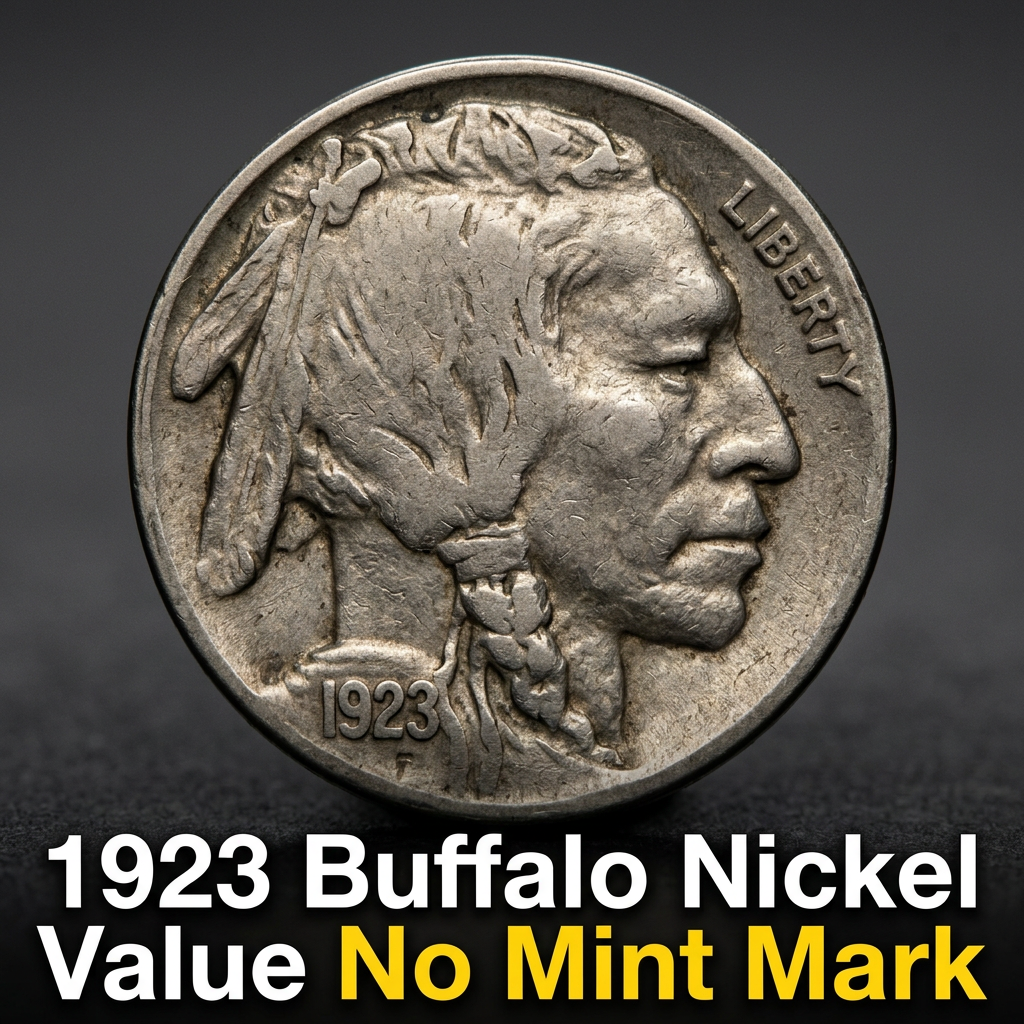
1923 Buffalo Nickel Value and Rarity Guide for No Mint Mark Coins
The 1923 Buffalo Nickel is worth anywhere from $1 in heavily worn condition to over $150 in uncirculated mint state. If you have recently discovered one of these iconic American coins in a jar or an old collection, you are likely holding a piece of history featuring one of the most beloved designs ever struck by the United States Mint.
Understanding the History of the 1923 No Mint Mark Nickel
The 1923 Buffalo Nickel, also known as the Indian Head Nickel, was designed by James Earle Fraser and features a powerful profile of a Native American on the obverse and an American bison on the reverse. When you find a 1923 nickel without a small letter “D” or “S” under the date, it means the coin was minted in Philadelphia. In 1923, the Philadelphia Mint produced over 35 million of these nickels. While this sounds like a high number, many of these coins were lost to circulation or were melted down over the decades, making high-quality survivors quite valuable today.
If you are unsure whether your coin is a genuine 1923 Philadelphia strike, you can use a free coin identifier app to instantly confirm its origin and variety. Using the CoinKnow app is a great way to get started with your collection, as it helps you recognize the subtle differences between different mint years. Because the date on Buffalo Nickels was designed on a raised surface, it often wore away quickly, meaning a 1923 nickel with a clear, readable date is already a step above many others found in the wild.
Evaluating the Condition and Grade of Your 1923 Nickel
Value in coin collecting is almost entirely determined by “grade,” which refers to the level of physical wear. A 1923 nickel that is smooth and lacks detail in the Native American’s hair or the bison’s fur will be worth closer to its face value or a small premium. However, collectors pay significantly more for coins that retain their original “mint luster”—that satiny sheen found on new coins. Finding a specimen in “About Uncirculated” or “Mint State” condition is the goal for any serious treasure hunter.
Checking the 1923 Buffalo Nickel price for mint state grades shows that even a small jump in quality can mean a difference of hundreds of dollars. Before you rush to a coin shop, you can use CoinKnow to compare your coin’s appearance against high-resolution photos of graded specimens. This allows you to estimate whether your coin is “Good,” “Fine,” or “Extra Fine” without needing professional equipment. Always handle your coins by the edges, as oils from your fingers can damage the metal and lower the potential resale value.
The Current Market Value of 1923 Philadelphia Nickels
Because there were no nickels minted in San Francisco or Denver in 1922, the 1923 release was met with high demand for commerce. Today, the market for these coins is steady. For an everyday American who finds one of these in a “Good” condition (well-worn but with a visible date), the value usually sits between $1.50 and $5.00. As the condition improves to “Very Fine,” where the horn of the buffalo is mostly visible, the price can climb toward $15.00 or $20.00.
To give you a better idea of what to expect, refer to the following 1923 Philadelphia nickel value data for various conditions. Most coins found in backyard searches or old piggy banks will fall into the Good to Fine categories, but it is always worth checking for those rare high-grade exceptions that collectors covet.
| Condition / Grade | Estimated Value (USD) |
|---|---|
| Good (G-4) | $1.25 – $2.00 |
| Fine (F-12) | $4.00 – $7.00 |
| Extremely Fine (EF-40) | $25.00 – $45.00 |
| Uncirculated (MS-60) | $75.00 – $110.00 |
| Choice Uncirculated (MS-65+) | $350.00+ |
What to Look For: Errors and Special Features
While the standard 1923 Buffalo Nickel is common, collectors are always on the lookout for errors that occurred during the minting process. While 1923 isn’t as famous for errors as the 1937-D “3-Legged Buffalo,” you should still inspect your coin closely. Look for “doubled dies,” where the lettering or the date appears to have a shadow or a second outline. These errors can significantly boost the value of even a worn coin, turning a $2 find into a hundred-dollar prize.
Using tools like the CoinKnow app can help you zoom in on these tiny details that are often invisible to the naked eye. If you notice anything unusual, such as a “clipped planchet” (where the coin looks like a bite was taken out of it) or “off-center strikes,” you may have found a rare mint error. These mistakes were supposed to be caught by inspectors at the Philadelphia Mint but occasionally slipped through into circulation, where they remained hidden for a century.
How to Sell or Collect Your 1923 Buffalo Nickel
If you decide you want to sell your coin, your best bet is to visit a local coin shop or list it on a reputable auction site. For more expensive, high-grade coins, having the coin “certified” by a professional service like PCGS or NGC is recommended. This provides a guarantee of the coin’s authenticity and grade, making it much easier to sell to serious collectors. For lower-grade coins, many people choose to keep them as a piece of American heritage.
Starting a Buffalo Nickel collection is a rewarding hobby that connects you to the history of the early 20th century. Whether you found just one 1923 nickel or a whole bag of them, knowing their worth is the first step toward becoming a savvy collector. Remember to keep your coins in a cool, dry place and never clean them with chemicals or abrasives, as this can destroy their numismatic value instantly.
Q: Where is the mint mark on a 1923 Buffalo Nickel?
A: The mint mark is located on the reverse side (the side with the buffalo), directly underneath the words “FIVE CENTS.” If there is no letter there, the coin was minted in Philadelphia.
Q: Why is the date on my 1923 nickel so hard to see?
A: The date on Buffalo Nickels was designed on a high point of the coin’s surface. Because of this, it was the first part of the design to wear away as the coin circulated in people’s pockets.
Q: Should I clean my 1923 Buffalo Nickel to make it worth more?
A: No, you should never clean old coins. Cleaning creates microscopic scratches on the surface and removes the original patina, which can reduce the coin’s value by 50% or more in the eyes of professional collectors.
