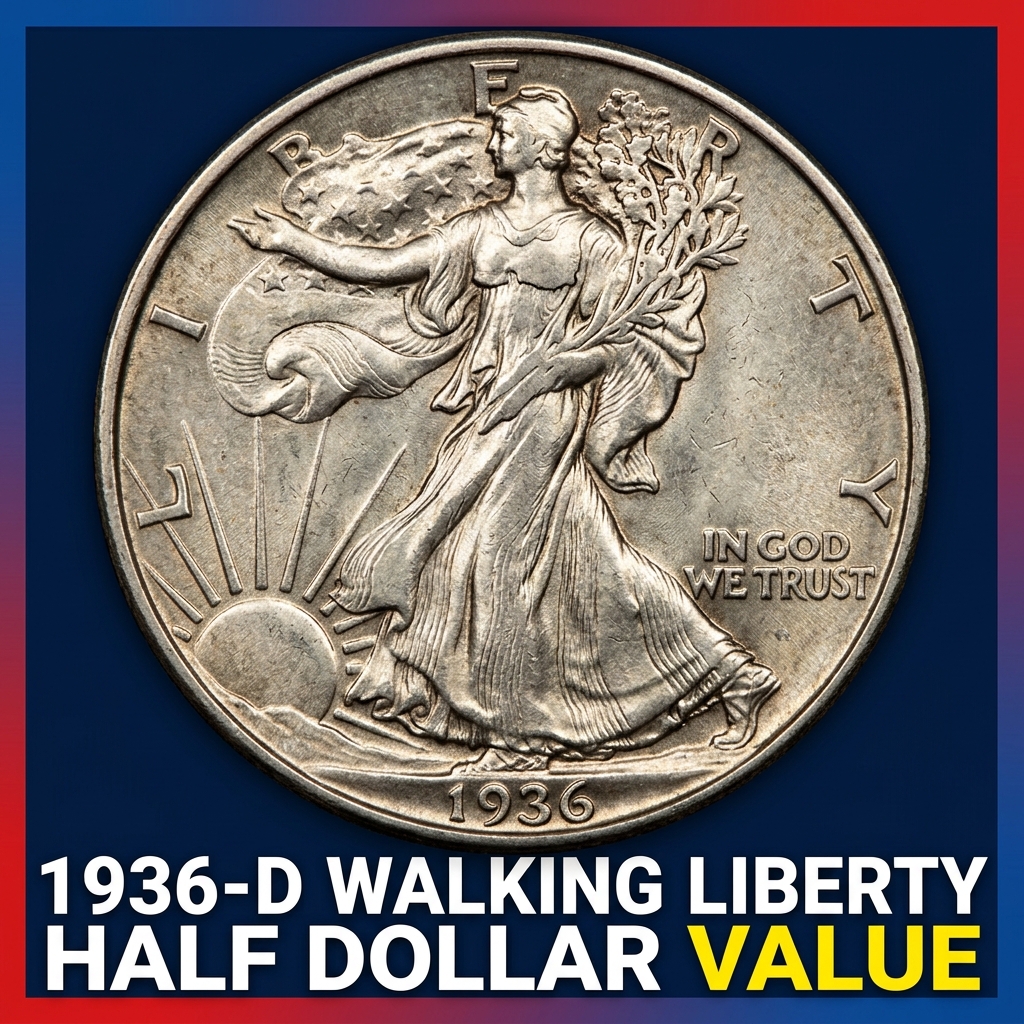
Value and History of the 1936-D Walking Liberty Half Dollar Explained
The 1936-D Walking Liberty Half Dollar is worth anywhere from $15 in heavily worn condition to over $600 for high-quality mint state examples. This beautiful silver coin is a favorite among collectors, and finding one in your change or an old collection is an exciting discovery for any American.
Identifying Your 1936-D Walking Liberty Half Dollar
The 1936-D Walking Liberty Half Dollar is widely considered one of the most beautiful coins ever minted by the United States. Designed by Adolph A. Weinman, it features Lady Liberty striding toward the sun, draped in the American flag. If you have found one of these coins, the first thing you should do is check the mint mark. On the 1936 issue, the mint mark is located on the reverse (the back) of the coin, near the rim at the 8 o’clock position.
For this specific coin, you are looking for a small “D,” which indicates it was produced at the Denver Mint. Knowing exactly what you have is the first step in determining its worth. You can use a free coin identifier app to quickly confirm the variety and date of your find. Once you’ve identified the “D” mint mark, you can begin to assess its physical state.
The Denver Mint produced about 2.1 million half dollars in 1936. While this sounds like a lot, many of these coins were used extensively in daily commerce during the tail end of the Great Depression. This means that finding one in “uncirculated” condition is much rarer than finding one that is smooth and worn. If you want a quick second opinion on your coin’s condition, the CoinKnow mobile application can help you categorize your coin’s grade.
Average Market Prices and Value Chart
The value of your 1936-D half dollar is primarily driven by its “grade,” or how much detail remains on Lady Liberty’s dress and the eagle’s feathers. Collectors pay a significant premium for coins that haven’t been scratched or worn down by years of circulation. Even in low grades, however, the coin is valuable because it is made of 90% silver.
The current value of a 1936 half dollar fluctuates based on the spot price of silver and collector demand. For most people who find these in old jars, the coin will fall into the “Good” to “Fine” range. However, if your coin still has its original “mint luster”—that shiny, satiny look it had when it was new—it could be worth much more.
| Condition / Grade | Estimated Value (USD) |
|---|---|
| Good (G-4) | $15 – $18 |
| Fine (F-12) | $22 – $28 |
| Extremely Fine (XF-40) | $45 – $60 |
| Uncirculated (MS-63) | $180 – $220 |
| Choice Uncirculated (MS-65+) | $550 – $1,200+ |
Why the Mint Condition 1936-D is Highly Prized
For serious numismatists, the 1936-D half dollar price in mint state can climb into the thousands of dollars if the coin is graded MS-66 or higher. At this level, the coin must have virtually no marks and a very sharp strike. Because Denver was known for producing high-quality strikes during this era, collectors often seek out 1936-D examples that show full lines on Lady Liberty’s skirt.
If you aren’t sure if your coin qualifies as “Mint State,” look at the highest points of the design: Liberty’s left breast and the eagle’s breast feathers. If these areas are flat and dull, the coin is circulated. If they are crisp and well-defined, you might have a high-value treasure. To track the value of your collection over time, many hobbyists use CoinKnow to keep an organized digital inventory of their silver holdings.
Interestingly, 1936 was a transitional year for the economy, and more people began saving coins as the country slowly emerged from the Depression. This is why we see a higher survival rate for the 1936-D compared to dates from the early 1920s. Nonetheless, any Walking Liberty half dollar is a “win” for a casual hunter.
How to Care for and Sell Your Old Half Dollars
When people find an old silver coin, their first instinct is often to clean it with polish or soap to make it look “new.” This is the biggest mistake you can make! Cleaning a 1936-D Walking Liberty Half Dollar will almost always lower its value to collectors. Collectors prefer the natural “patina” or toning that builds up over decades.
If you are ready to sell your coin, you have several options. Local coin shops are great for quick cash, but they need to make a profit, so expect to receive a bit less than the “book value.” For more valuable uncirculated coins, online auctions or professional grading services like PCGS or NGC might be the better route.
Before you head to a dealer, do your homework using tools like CoinKnow to see what similar coins have sold for recently. This ensures you go into any negotiation with a realistic expectation of what your silver half dollar is worth in today’s market.
Q: Is the 1936-D Walking Liberty Half Dollar made of real silver?
A: Yes, it is composed of 90% silver and 10% copper. Each coin contains approximately 0.36169 ounces of pure silver, giving it significant “melt value” even if it is in poor condition.
Q: Where is the mint mark on a 1936-D half dollar?
A: The “D” mint mark is located on the reverse side of the coin. Look at the lower left area, near the rim, just below the branch the eagle is perched on.
Q: How can I tell if my 1936-D half dollar is rare?
A: While the 1936-D is not a “key date” (ultra-rare), it is rare in high grades. If your coin looks like it just came from the bank and has no wear on Liberty’s knee or the eagle’s wing, it is considered rare and valuable.
