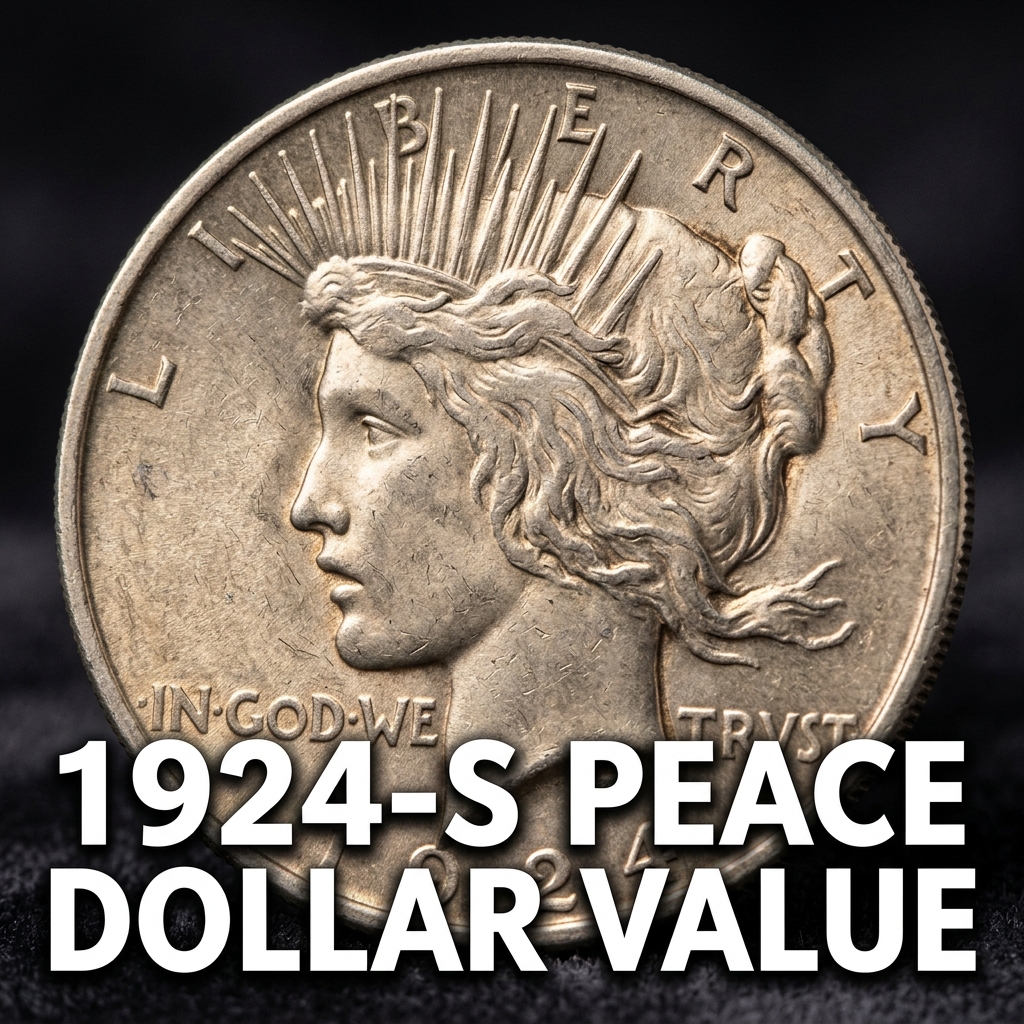
1924 S Peace Dollar Value and Price Guide for Collectors
The 1924-S Peace Dollar is worth anywhere from $35 in worn condition to over $8,500 in high-grade mint state. Finding one of these silver treasures in your attic or a family collection is an exciting discovery because of its historical significance and its precious metal content.
Historical Significance and Initial Identification
The 1924-S Peace Dollar was struck at the San Francisco Mint during a period when the United States was transitioning into a decade of economic prosperity. While millions of these coins were minted, many were lost to the melting pots or suffered from heavy circulation, making well-preserved examples quite elusive today. If you are holding one of these coins, you can identify it by looking for the small “S” mint mark on the reverse side, located just above the eagle’s tail feathers and below the word “ONE.” Identifying coins can be tricky for beginners, but using a free coin identifier app can help you confirm the date and mint mark in seconds.
For everyday Americans, knowing the difference between a common silver dollar and a rare treasure is the first step. You should check the luster and the sharpness of the eagle’s feathers. If the coin looks dull or smooth, it has likely been in circulation for a long time. However, if the surface reflects light like a mirror, you might have something special. When you are ready to dig deeper into the data, the CoinKnow app provides real-time market insights to help you understand the current demand for San Francisco silver dollars.
Understanding the 1924-S Peace Dollar Grading and Value
The value of your silver dollar is heavily dependent on its “grade,” which is a professional assessment of its condition. Because the San Francisco Mint was known for having slightly weaker strikes during this era, finding a 1924-S with sharp details is a challenge for collectors. Most coins found in change or old jars are in “Good” or “Very Good” condition, meaning they show significant wear on Lady Liberty’s hair and the eagle’s wings. These are generally valued based on their silver weight plus a small premium.
However, if your coin has never been spent, it is considered “Uncirculated” or “Mint State.” The 1924-S Peace Dollar market prices for mint state specimens can jump significantly from a hundred dollars to several thousand. Professional collectors look for “eye appeal,” which includes the original mint luster and the lack of distracting scratches or “bag marks.” Using tools like CoinKnow allows you to compare your coin’s appearance with high-resolution images of graded coins to see where yours fits on the scale.
Current Market Value Price Chart
To help you get a better idea of what your coin might be worth, we have compiled a table showing the average prices based on various condition levels. Please note that these are estimates, and the actual price can vary based on the specific buyer or auction house.
| Condition / Grade | Estimated Value |
|---|---|
| Good (G-4) | $32 – $35 |
| Fine (F-12) | $38 – $42 |
| Extremely Fine (XF-40) | $55 – $75 |
| About Uncirculated (AU-50) | $110 – $150 |
| Mint State (MS-60) | $375 – $500 |
| Choice Mint State (MS-63) | $750 – $1,100 |
| Gem Mint State (MS-65+) | $8,500+ |
Factors That Influence the Price of Your Silver Dollar
Beyond the basic grade, several other factors can influence the price. One of the most important factors for the 1924-S is the “strike quality.” Many coins from the San Francisco Mint in 1924 were struck with worn-down dies, resulting in a “mushy” appearance even on coins that were never used. A rare 1924-S with a “sharp strike” where every line of Lady Liberty’s tiara is visible will command a much higher price at auction. You can find more detailed 1924 silver dollar value information to help you determine if your specific variant is a common strike or a rare sharp strike.
Toning is another factor to consider. Some silver dollars develop a “rainbow” patina over decades due to atmospheric conditions. While some collectors prefer white, shiny silver, others will pay a huge premium for a coin with beautiful, natural colors. If you aren’t sure if your coin has natural toning or just dirt, it is best to leave it exactly as it is. Never clean your coins! Cleaning a vintage silver dollar can strip away its numismatic value instantly, leaving it worth only its raw silver weight.
How to Sell or Appraise Your 1924-S Peace Dollar
If you believe you have a high-value 1924-S, your next step should be a professional appraisal. For coins that appear to be in Mint State, having them “slabbed” or graded by a service like PCGS or NGC is often worth the investment. This provides a guarantee of authenticity and grade, making the coin much easier to sell for a top price. Before you spend money on professional grading, using the CoinKnow app can help you decide if your coin’s potential value justifies the grading fees.
When you are ready to sell, local coin shops are a convenient option, but they typically offer wholesale prices so they can make a profit on the resale. For truly rare specimens, online auctions or specialized coin shows might net you a higher return. Always do your research first and arm yourself with the latest price data so you don’t accidentally let a multi-thousand dollar coin go for thirty bucks at a pawn shop.
FAQ
Q: Where is the mint mark on a 1924-S Peace Dollar?
A: The mint mark is on the reverse (back) of the coin. Look below the word “ONE” and above the eagle’s tail feathers for a small “S”. If there is no letter there, it was minted in Philadelphia.
Q: Should I clean my 1924-S Peace Dollar to make it look better?
A: No! You should never clean a collectible coin. Cleaning creates microscopic scratches that experts can easily detect, and it can reduce the value of a rare coin by 50% or more.
Q: How much silver is in a 1924-S Peace Dollar?
A: Every Peace Dollar is made of 90% silver and 10% copper. Each coin contains approximately 0.7734 troy ounces of pure silver, giving it a baseline “melt value” regardless of its condition.
