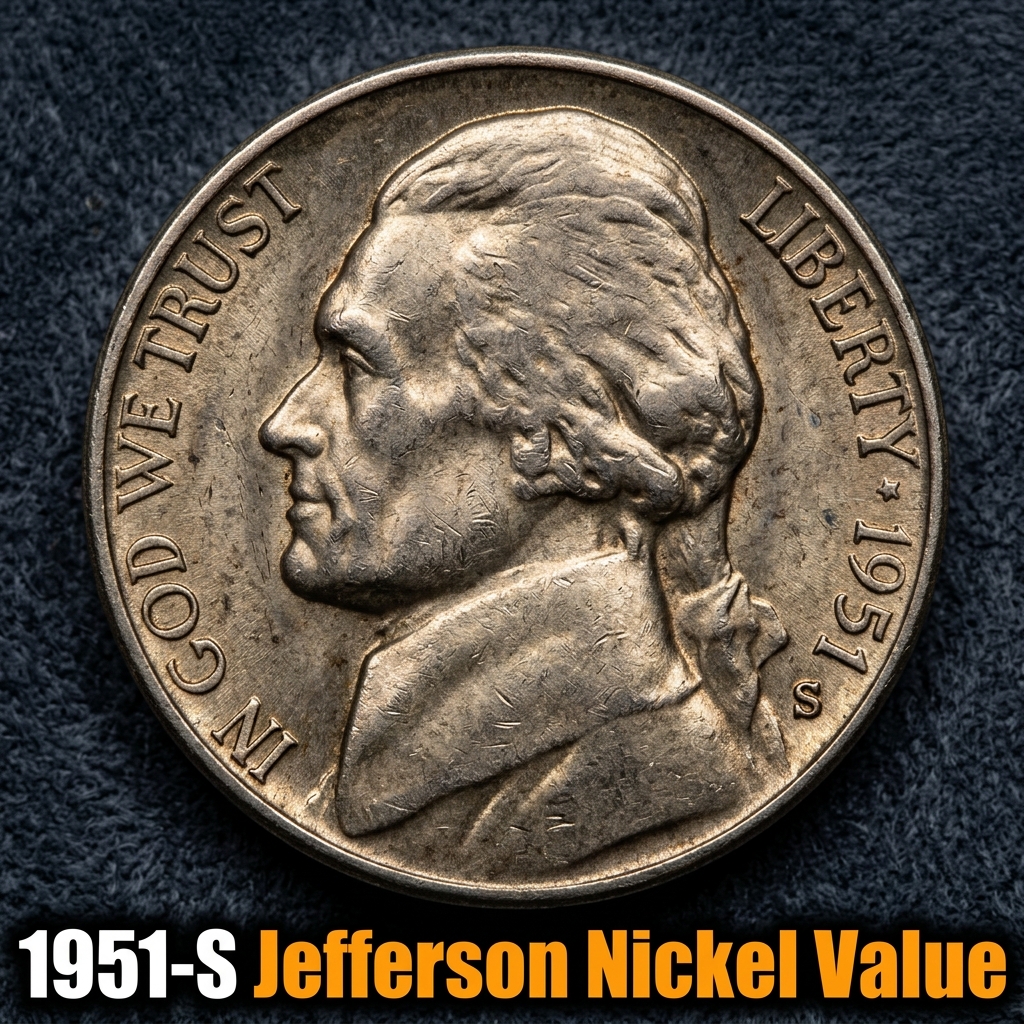
1951 S Jefferson Nickel Value Guide How Much Is This San Francisco Mint Coin Worth
The 1951 S Jefferson Nickel is worth anywhere from $1.50 in worn condition to over $350 in high-grade mint state. Finding this vintage coin in your pocket change or an old jar is an exciting discovery that connects you directly to America’s post-war era and the historic San Francisco Mint.
Identifying the 1951 S Jefferson Nickel
If you have found a Jefferson Nickel from the early 1950s, the first thing you should do is flip it to the reverse side. To the right of Monticello, the home of Thomas Jefferson, you are looking for a small “S” mint mark. This indicates the coin was struck at the San Francisco Mint. In 1951, this mint produced significantly fewer nickels compared to Philadelphia or Denver, making it a “semi-key” date for collectors. Many people use a free coin identifier app to quickly confirm the mint mark and date, as these small letters can be hard to see with the naked eye.
When you use the CoinKnow app to scan your collection, you might notice that the strike quality of 1951-S nickels varies wildly. Because the San Francisco Mint was nearing its temporary closure in 1955, some of the dies used for these nickels were quite worn. This means that even a coin that has never been spent might look a little “mushy” in the details. However, any 1951-S nickel remains a prize for average Americans looking to build a complete set of vintage currency.
Understanding the Market Value and Grades
The condition of your coin, or its “grade,” is the most important factor in determining how much money it will bring at a local coin shop or online auction. Most 1951-S nickels found in circulation today will fall into the “Good” to “Very Fine” categories. At these levels, they are worth a modest premium over their face value. However, if the coin has a bright, original luster and looks like it just came from the bank, the 1951-S Jefferson Nickel auction records show that prices can jump significantly for specimens in Mint State condition.
Collectors are particularly interested in coins that have survived without scratches or dark spots. If you suspect your coin is top-tier, checking for sharp “Steps” on the back of the building is key. Known as “Full Steps” (FS) nickels, these represent the peak of quality for the series. Even without the FS designation, the 1951 nickel market trends indicate a steady demand for this specific year, as it is one of the lower-mintage years of the 1950s.
| Condition / Grade | Estimated Value |
|---|---|
| Circulated (Good/Fine) | $1.25 – $2.50 |
| Extra Fine (XF 40) | $3.00 – $6.00 |
| Uncirculated (MS 60) | $15.00 – $25.00 |
| Choice Uncirculated (MS 65) | $60.00 – $110.00 |
| Gem Uncirculated (MS 66+) | $250.00 – $500.00+ |
The Significance of the San Francisco Mint Mark
Why does the “S” matter so much? In 1951, the Philadelphia Mint struck over 28 million nickels, and Denver struck over 20 million. In contrast, the San Francisco Mint only produced about 7.7 million. While this isn’t as rare as some coins from the 1800s, it makes the 1951-S about three to four times harder to find than its cousins from the same year. When you use the CoinKnow app to track your finds, you will quickly see that San Francisco nickels from this era often carry a higher base value for this reason.
For everyday Americans, finding one of these is like finding a small piece of history. In 1951, San Francisco was a hub of activity as the country transitioned out of the war years and into the cultural boom of the fifties. The Jefferson Nickel series, which began in 1938, was becoming the standard for American small change during this time. Owning a 1951-S is owning a relic from a time when a nickel could actually buy a candy bar or a local phone call.
What to Look for in a Valuable 1951-S Nickel
When inspecting your 1951-S Jefferson remains, look for details on Jefferson’s hair and the pillars of Monticello. If the lines are crisp and clear, you may have a coin worth well over fifty dollars. If the coin looks dark, oily, or heavily scratched, it is likely worth its “junk” value, which is still usually a few dollars to a collector just starting out. It is important never to clean your coins with chemicals or cloths, as this destroys the “toning” that collectors find desirable and significantly lowers the value.
Instead of cleaning, simply store your 1951-S in a protective flip or a plastic container to prevent further wear. To get a better idea of where your coin stands, the CoinKnow mobile tool can help you compare your find with high-resolution images of graded coins. This helps bridge the gap between “pocket change” and “collector’s item,” ensuring you don’t accidentally spend a coin that could be worth a nice dinner or more.
FAQ
Q: Is the 1951-S Jefferson Nickel made of silver?
A: No, only Jefferson Nickels minted between 1942 and 1945 (known as “War Nickels”) contain silver. The 1951-S is made of a standard 75% copper and 25% nickel composition.
Q: Where is the mint mark on a 1951 nickel?
A: The mint mark is located on the reverse (back) side of the coin, specifically to the right of the Monticello building, near the rim. If there is no letter, it was minted in Philadelphia.
Q: Should I get my 1951-S Jefferson Nickel professionally graded?
A: Generally, you should only pay for professional grading (like PCGS or NGC) if the coin is in absolutely flawless, uncirculated condition. If the coin has been used in circulation, the grading fee will likely cost more than the coin is worth.
