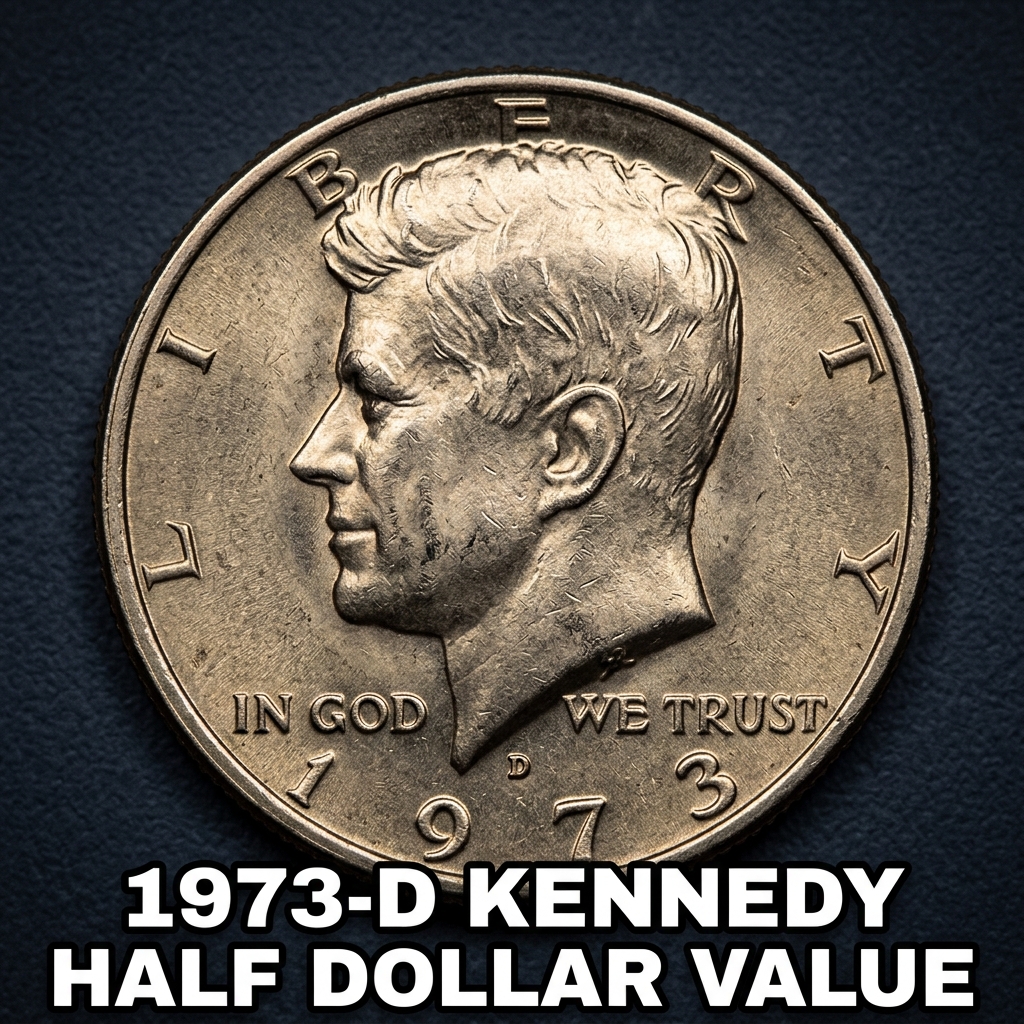
1973 D Kennedy Half Dollar Value and Ultimate Collector Price Guide
The 1973-D Kennedy Half Dollar is worth anywhere from its $0.50 face value in circulated condition to over $1,200 in high-grade mint state. Finding one of these large silver-colored coins in your pocket change or an old jar can be an exciting moment for any casual collector.
Understanding the Basics of your 1973-D Half Dollar
If you have discovered a 1973 Kennedy Half Dollar with a small “D” mint mark, you are holding a piece of American history minted in Denver, Colorado. By 1973, the United States Mint had transitioned away from using silver for circulating half dollars, meaning your coin is composed of a copper-nickel clad mix. While these aren’t “silver” in the traditional sense, they remain a staple of the Kennedy series that began in 1964 to honor the legacy of President John F. Kennedy. If you are unsure if your coin is a specific variety or just a common strike, using a free coin identifier app can help you confirm the details in seconds.
Most of the coins you find in circulation today will show signs of wear and tear, such as scratches or smoothed-out details on JFK’s hair. For the average person, these circulated coins are generally worth their face value of fifty cents. However, professional collectors are always on the hunt for “Mint State” examples—coins that never actually spent time in a cash register. Determining the exact quality of your coin is where tools like the CoinKnow app come in handy, allowing you to compare your coin against high-resolution images of certified grades.
What Determines the Value of a 1973-D Kennedy Half Dollar
The most significant factor in the value of a 1973-D Kennedy Half Dollar is its physical condition, also known as its “grade.” Coins are graded on a scale from 1 to 70. A coin that looks shiny and “new” is likely in the MS60 to MS63 range. These might sell for a few dollars. However, once you reach the elite grades of MS66 or MS67, the price skyrockets. Because these coins were produced in large quantities—over 64 million at the Denver mint alone—finding one that has survived 50 years without a single scratch is rare.
Collectors often look for a “strong strike,” where the details of the eagle’s feathers on the reverse and Kennedy’s portrait on the obverse are crisp and sharp. If you think you’ve found a particularly shiny specimen, checking the current 1973-D Kennedy half dollar price list can give you a better idea of what dealers are currently paying. Keep in mind that “uncirculated” doesn’t just mean it looks good; it means it has its original mint luster, that shimmering “cartwheel” effect when you tilt the coin under a light.
| Condition / Grade | Estimated Market Value |
|---|---|
| Circulated (Good to About Uncirculated) | $0.50 – $1.00 |
| Mint State 63 (Uncirculated) | $3.00 – $8.00 |
| Mint State 65 (Gem Uncirculated) | $20.00 – $45.00 |
| Mint State 67+ (Rare Elite Grade) | $800.00 – $1,500.00+ |
How to Spot Rare 1973-D Error Varieties
Beyond the standard grade, some 1973-D Half Dollars are worth more because of “mint errors.” These happen when something goes wrong during the manufacturing process. Common errors for this year include “Double Die” strikes, where the lettering or the profile of Kennedy appears doubled. Another valuable error is the “clipped planchet,” where a piece of the coin’s edge is missing in a curved shape. Identifying these requires a keen eye or a specialized magnifying glass.
If you enjoy the hunt for these unique treasures, the CoinKnow app provides a database of known errors to help you spot them. For those looking for comprehensive 1973-D Kennedy half dollar worth information, it is essential to distinguish between a damaged coin and a genuine mint error. A coin that was flattened on a train track is just damaged, but a coin that was struck on the wrong metal blank could be worth thousands of dollars to a serious numismatist.
Should You Get Your 1973-D Half Dollar Graded
Professional grading by companies like PCGS or NGC can be expensive, often costing $30 to $50 per coin. For most 1973-D Kennedy Half Dollars, this isn’t worth it. If your coin is worth $1, spending $50 to grade it doesn’t make financial sense. However, if you believe you have a “Gem” coin in MS67 condition or better, professional authentication is necessary to realize its full market value. Average Americans should first use the CoinKnow app to get a preliminary assessment.
When examining your coin, look for deep scratches, “bag marks” (nicks from coins hitting each other in bags at the mint), and signs of cleaning. Ironically, cleaning a coin actually lowers its value significantly. Collectors prefer the original “patina” or tarnish that comes with age. If your 1973-D looks oddly white or scrubbed, it is likely worth only its face value. Keep your coins in their found state and handle them only by the edges to preserve any potential value you might have found.
Q: Is the 1973-D Kennedy Half Dollar made of silver?
A: No, the 1973-D Kennedy Half Dollar is a copper-nickel clad coin. The US Mint stopped using silver for circulating half dollars after 1970.
Q: Where is the “D” mint mark located on the 1973 half dollar?
A: You can find the “D” mint mark on the front (obverse) of the coin, just above the date 1973 and below the truncation of Kennedy’s neck.
Q: I found a 1973 half dollar with no mint mark. Is it rare?
A: A 1973 half dollar with no mint mark simply means it was minted in Philadelphia. These are very common and have a similar value range to the Denver (D) strikes.
