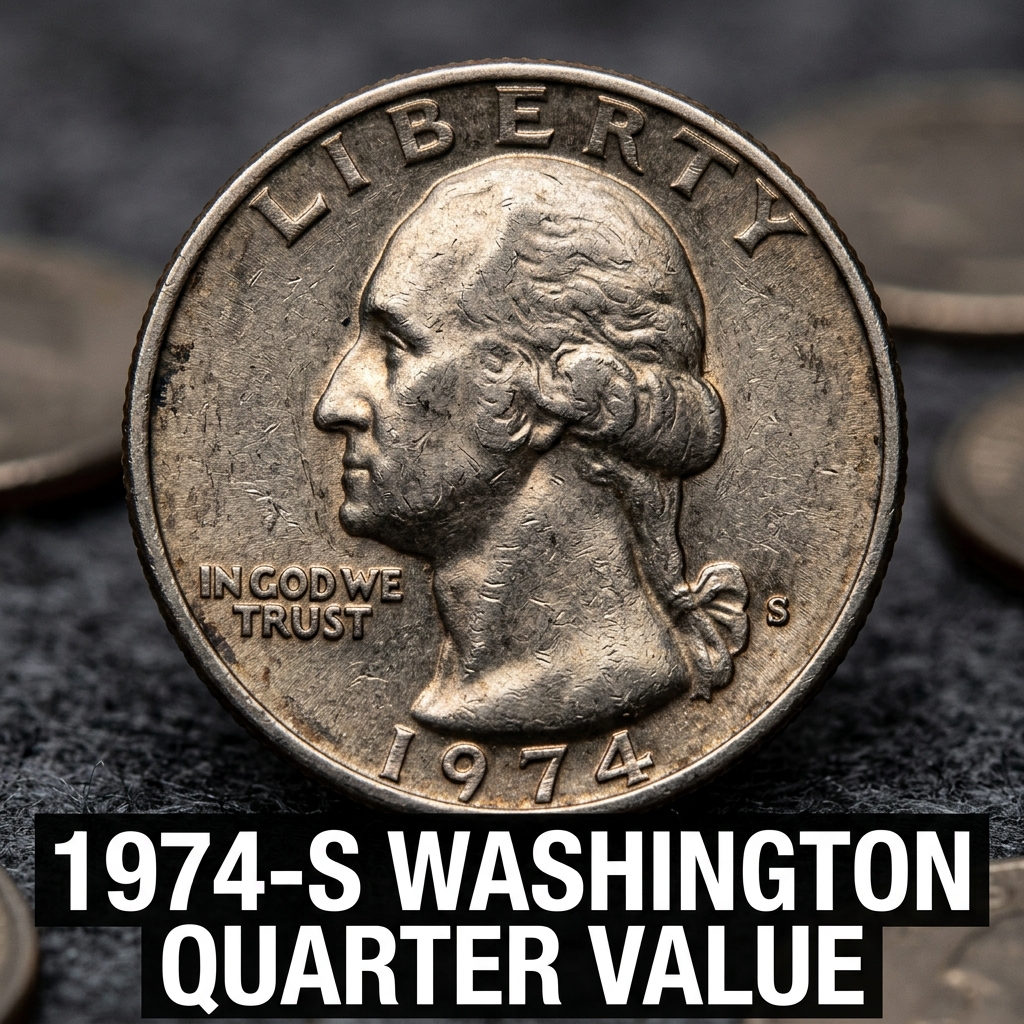
1974 S Washington Quarter Value and Complete Guide to Identifying Rare Proof Coins
The 1974-S Washington Quarter is worth anywhere from $1.50 in typical Proof condition to over $400 for high-grade specimens. Finding one in your pocket change or an old collection is an exciting discovery, as these coins were never intended for general circulation and carry a unique history.
Understanding the Special Nature of the 1974-S Washington Quarter
If you have found a Washington Quarter dated 1974 with an “S” mint mark, you have found a Proof coin. Unlike the millions of quarters struck in Philadelphia or Denver for daily commerce, the San Francisco Mint produced these specifically for collectors. You can easily identify these coins by their mirror-like finish and sharp, frosted details.
If you aren’t sure if the coin in your hand is a genuine proof or just a shiny regular issue, using a free coin identifier app can help you confirm the mint mark and strike type instantly. For many everyday Americans, these coins appear in inherited collections or “Mint Sets” that families saved decades ago.
While the 1974-S was minted in a quantity of over 2.6 million, the vast majority were kept in protective plastic cases. When a 1974-S quarter is found in loose change, it is often referred to as an “impaired proof,” meaning it has lost some of its luster through handling, yet it still holds a premium over its face value. Using the CoinKnow app can help you track these small price differences as you build your collection.
How to Determine the Value of Your 1974-S Quarter
The value of a 1974-S Washington Quarter depends almost entirely on its physical condition and visual appeal. Because these coins were struck using polished dies, collectors look for “Cameo” or “Deep Cameo” effects. A “Deep Cameo” 1974-S features a stark contrast where the portrait of George Washington looks frosty white against a background that looks like a black mirror.
For most casual finders, a standard 1974-S Proof is worth between $1.50 and $5.00. However, if your coin is in perfect condition with no visible scratches even under a magnifying glass, the price can climb significantly. You can check the current market trends for 1974-S quarter auction records and values to see how much professional collectors are paying for top-tier grades today.
Because the CoinKnow app utilizes advanced image recognition, it can help you spot the difference between a common proof and one that might be worth a professional grading submission. Most 1974-S quarters are sold as part of a complete 1974 Proof Set, but individual coins remain popular for those trying to complete a “hole” in their blue Whitman coin folders.
| Condition Grade | Estimated Market Value |
|---|---|
| PR 63 (Typical Proof) | $1.50 – $2.50 |
| PR 67 (High Quality) | $6.00 – $10.00 |
| PR 69 Deep Cameo (Near Perfect) | $25.00 – $45.00 |
| PR 70 Deep Cameo (Perfect Grade) | $350.00+ |
What Makes a 1974-S Quarter Rare or Valuable?
While the “S” mint mark tells you where the coin was made, the metal composition and strike quality determine the final price. Unlike older quarters from before 1964, the 1974-S is not made of silver. It is a copper-nickel clad coin. This means it doesn’t have intrinsic “melt value” like a silver coin, but its numismatic value remains steady.
The highest prices are reserved for coins that have earned the “Deep Cameo” (DCAM) designation from grading services like PCGS or NGC. A perfect PR70 Deep Cameo is a rarity because even a tiny microscopic piece of dust on the die during production could prevent a coin from reaching this tier. You can find detailed descriptions of 1974-S Washington Quarter value factors and grading tips to help you decide if yours is worth sending in for certification.
Errors are another way a 1974-S can be worth more than a few dollars. While rare in proof sets, some collectors look for “doubled die” errors where the lettering or the date appears to have a slight shadow or ghost image. If you suspect an error, the CoinKnow app is a great resource to compare your coin against known error varieties in their database.
Storing and Selling Your 1974 Washington Proof Quarter
If you have found a 1974-S in good condition, the most important thing you can do is stop touching it with your bare hands. The oils from your skin can cause permanent fingerprints on the delicate mirror finish of a proof coin, which will immediately lower its value to a collector.
Instead, hold the coin only by its edges and place it in a PVC-free plastic flip or a cardboard “2×2” holder. This preserves the luster that makes the “S” mint mark coins so desirable. When you are ready to sell, local coin shops are a good place for quick cash, but online auctions often yield the best prices for high-grade 1974-S specimens because you are reaching a nationwide audience of 1970s coinage enthusiasts.
Always remember that the 1974-S was the last year of the “classic” Washington design before the mint switched to the Bicentennial “Drummer Boy” reverse in 1975 and 1976. This makes the 1974-S a popular “type coin” for people who want the final version of the original design in its highest possible quality.
Q: Is the 1974-S quarter made of silver?
A: No, the 1974-S Proof Quarter is a clad coin made of a copper core with a nickel-copper outer layer. The San Francisco Mint did not produce silver quarters for circulation or standard proof sets in 1974.
Q: How can I tell the difference between a 1974-S and a regular 1974 quarter?
A: The most obvious difference is the “S” mint mark located to the right of George Washington’s ponytail. Additionally, 1974-S coins have a mirror-like background and very sharp details, whereas regular 1974 quarters from Philadelphia (no mint mark) or Denver (D) have a duller, matte finish.
Q: Is it worth getting a 1974-S quarter professionally graded?
A: Generally, it is only worth grading if the coin appears to be in perfect (PR70) condition. Since the cost of grading can be $30-$50 per coin, the coin needs to be worth significantly more than that to justify the expense. Most 1974-S quarters are better kept in simple protective holders.
