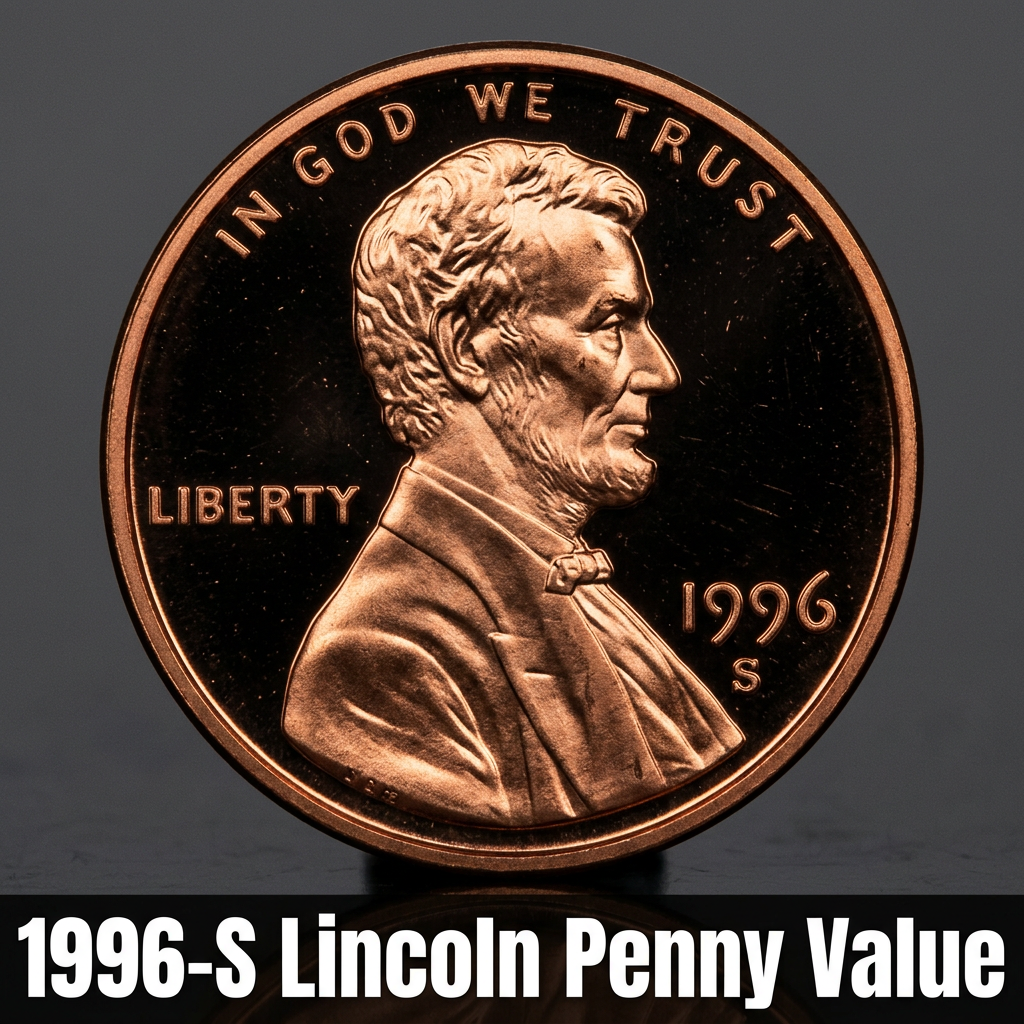
1996 S Lincoln Penny Value and Guide for Rare Proof Cents
The 1996-S Lincoln Penny is worth anywhere from $2 in typical proof condition to over $1,000 for rare high-grade specimens. While most pennies you find in your pocket are meant for spending, those minted with the “S” mark were crafted specifically for collectors and hold a unique place in numismatic history.
What Makes the 1996 S Lincoln Penny Special
If you have discovered a shiny penny dated 1996 with a small “S” below the date, you have found a Proof coin from the San Francisco Mint. Unlike the billions of 1996 pennies struck in Philadelphia or Denver for general circulation, the San Francisco Mint produced only about 2.5 million of these for special collector sets. Using a free coin identifier app is the fastest way to confirm your coin’s origin and current market trend.
These coins are struck twice on specially polished planchets or “blanks,” giving them a mirror-like finish and sharp details. When you hold one up to the light, the background should look like a dark mirror, while Lincoln’s portrait appears frosted. This “Deep Cameo” effect is what collectors look for. If you find one in a collection, you might want to use the CoinKnow app to keep track of its historical price movements.
Current Market Value for 1996 S Proof Cents
Most 1996-S Lincoln Cents found in original government packaging are worth a few dollars. However, the price skyrockets as the grade approaches perfection. Professional graders use a scale from 1 to 70, and a “Deep Cameo” (DCAM) designation is essential for top-tier value.
| Condition / Grade | Estimated Market Value |
|---|---|
| PR 65 Deep Cameo | $2.00 – $5.00 |
| PR 68 Deep Cameo | $10.00 – $15.00 |
| PR 69 Deep Cameo | $20.00 – $35.00 |
| PR 70 Deep Cameo | $350.00 – $1,100.00 |
For everyday collectors, a 1996 penny in high-grade red condition can yield surprising returns if it is flawlessly preserved. While a PR69 is common and affordable, a perfect PR70 is incredibly rare because even the tiniest microscopic scratch from the minting process can drop the grade.
Common Errors and Variations in 1996 Pennies
While the 1996-S is the star for proof collectors, you should also be on the lookout for errors on the standard 1996 and 1996-D circulation coins. Double die errors are the most sought after, where the letters or numbers appear slightly doubled. You can check the 1996 Lincoln cent valuation details to see if your specific variation carries a premium.
Another thing to look for is the “Close AM” vs. “Wide AM” variety on the reverse. For 1996, the standard is the “Wide AM” (where the letters A and M in AMERICA are clearly separated). If you find a proof coin with a “Close AM,” you might have a significant rarity on your hands. Apps like CoinKnow allow you to upload high-resolution photos to help identify these subtle differences that distinguish a common cent from a treasure.
Is Your 1996-S Penny Worth Grading?
Determining whether to send your coin to a professional grading service like PCGS or NGC depends heavily on its condition. If the coin has scratches, fingerprints, or “toning” (discoloration), it likely won’t hit the PR70 mark required to justify the grading fees.
Most 1996-S pennies are best kept in their original plastic cases or archival-safe flips. Before spending money on professional services, we recommend using CoinKnow to compare your coin’s appearance against high-resolution images of certified specimens. This helps you avoid spending $30 on grading a coin that is only worth $5.
Frequently Asked Questions
Q: Can I find a 1996-S Lincoln Penny in my pocket change?
A: It is very rare. Since these were only sold in sets to collectors, they usually only enter circulation if someone breaks open a set or a thief spends a collection. If found, they are usually scratched and lose most of their collector value.
Q: What does the “S” mint mark stand for?
A: The “S” stands for the San Francisco Mint. In 1996, this facility focused primarily on producing high-quality proof sets for collectors rather than money for daily commerce.
Q: Why is the PR70 grade so much more expensive than PR69?
A: In the world of coin collecting, “perfect” coins are exceptionally rare. While thousands of 1996-S pennies might look perfect to the naked eye, only a small fraction are found to be flawless under 5x magnification by professional graders.
