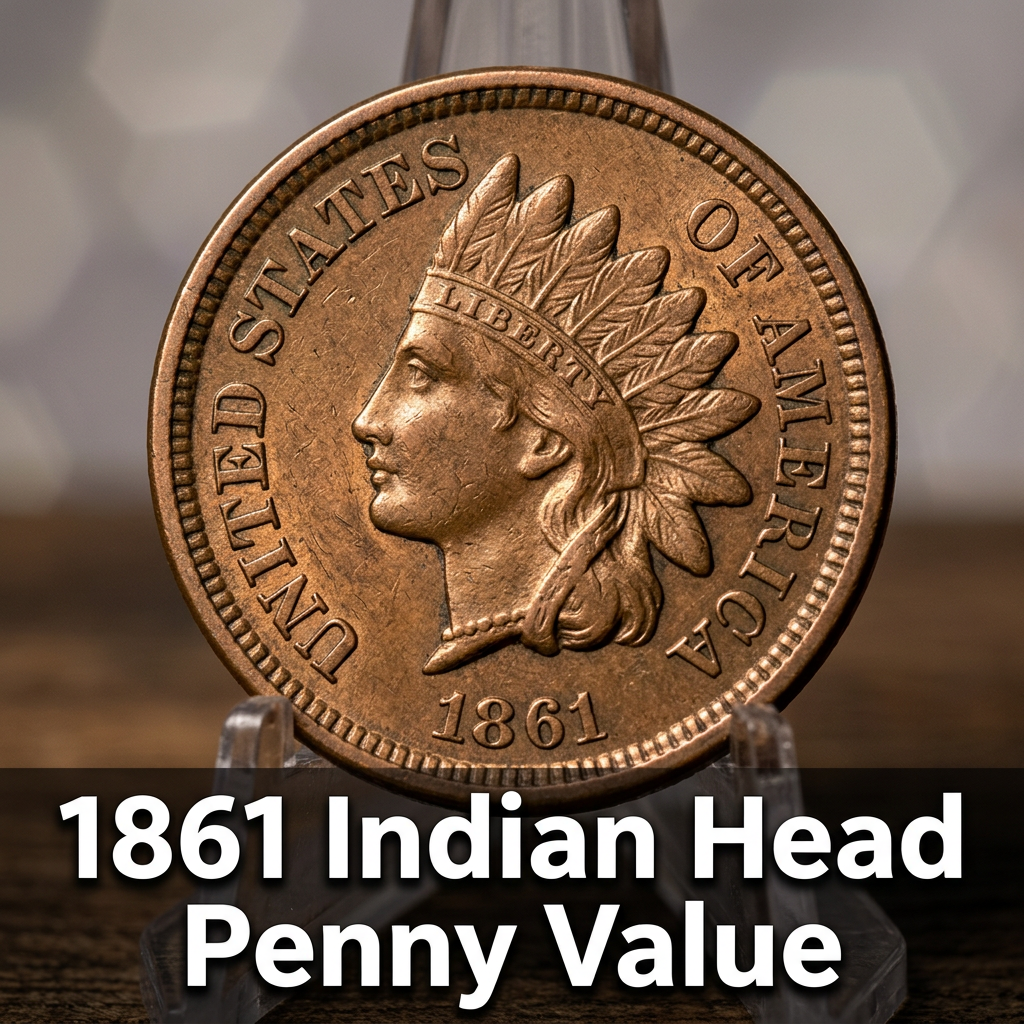
Current Market Rare 1861 Indian Head Penny Values and Identification Guide
The 1861 Indian Head Penny is worth anywhere from $25 in heavily worn condition to over $1,000 for high-grade uncirculated specimens. This Civil War-era copper-nickel cent is a prized find for treasure hunters and metal detectorists because of its historical significance and low survival rate in pristine condition.
Why the 1861 Indian Head Penny is a Special Find
If you just discovered an 1861 Indian Head Penny in an old jar of change or inherited a collection, you are holding a piece of American history. Struck during the first year of the American Civil War, these coins were produced at the Philadelphia Mint during a time of immense national turmoil. Because people tended to hoard metal during the war, many of these cents saw heavy circulation or were lost to time. Identifying exactly what you have can be tricky for a beginner, which is why many collectors use a free coin identifier app to get instant feedback on their finds.
Unlike the modern zinc or copper pennies we use today, the 1861 version is thicker and has a distinct pale color. This is because it is a “White Penny,” composed of 88% copper and 12% nickel. When you are assessing your coin, look closely at the feathers in Lady Liberty’s headdress. If you can see the word “LIBERTY” clearly on the headband, you likely have a coin worth significantly more than the base collector price. For those who want more precise technical details, using the CoinKnow app can help you zoom in on these high-relief areas to check for wear.
Understanding the Grade and Value Range
The value of your 1861 Indian Head Penny depends almost entirely on its “grade,” or its state of preservation. Coins that have been pulled from the ground or found in circulating bags are usually in “Good” or “Very Good” condition. In these states, the “L” in Liberty is usually worn away, and the leaves on the reverse wreath are flat. However, even in these lower grades, the coin maintains a solid floor price because of its age. If you are lucky enough to find one that still has its original luster, you are looking at a much higher payout.
To help you estimate what your coin might bring at an auction or a local coin shop, refer to the 1861 Indian Head Penny auction prices for Mint State grades. Collectors pay a massive premium for coins that haven’t been scratched or “cleaned.” A common mistake many people make is trying to scrub an old penny to make it look shiny. Never clean your coins! Cleaning creates microscopic scratches that can slash the value of a rare penny by 50% or more. Use the CoinKnow app to compare your coin images with high-resolution examples before deciding how to handle it.
| Condition / Grade | Estimated Value |
|---|---|
| Good (G-4) | $25 – $32 |
| Very Good (VG-8) | $40 – $55 |
| Fine (F-12) | $75 – $95 |
| Extremely Fine (EF-40) | $160 – $210 |
| About Uncirculated (AU-50) | $275 – $350 |
| Uncirculated (MS-60+) | $450 – $1,200+ |
Key Characteristics and Varieties to Look For
When examining your change, it helps to know that the United States Mint produced approximately 10.1 million pennies in 1861. While this sounds like a lot, very few survived the war years without significant damage. When comparing this date to other years, such as the 1898 Indian Head Penny worth and history, you will notice that the 1861 version is significantly more expensive in every category. This is due to the “Fatty” composition of the early 1860s coins combined with the low survival rate.
Keep an eye out for “Proof” versions as well. The mint produced about 1,000 proof coins for collectors that year. These appear much shinier, with mirror-like backgrounds and sharp, frosty details. A Proof 1861 penny can easily sell for over $3,000. If you aren’t sure if your coin is a regular strike or a proof, it is highly recommended to get it appraised. CoinKnow allows you to connect with experts who can help distinguish between a well-preserved business strike and a rare proof specimen.
How to Safely Store and Sell Your Antique Cents
Storing your 1861 Indian Head Penny correctly is vital to maintaining its worth. Since these coins contain nickel, they are prone to “clouding” if kept in high-humidity areas. We recommend using PVC-free coin flips or plastic capsules. Avoid keeping them in PVC-based soft plastic sleeves, as the chemicals can leak out and cause a green, sticky residue known as “PVC damage,” which permanently ruins the coin’s surface.
When you are ready to sell, do your homework first. Check recent auction results on eBay or specialized numismatic sites to see what similar coins have actually sold for, rather than just looking at asking prices. For most casual sellers, a local reputable coin dealer is the fastest way to get cash, though they will typically offer you 60-70% of the retail value so they can make a profit. If your coin is in exceptional condition, consider having it professionally graded by companies like PCGS or NGC to maximize your return.
Q: Is there a mint mark on the 1861 Indian Head Penny?
A: No, all 1861 Indian Head Pennies were struck at the Philadelphia Mint, and at that time, Philadelphia did not use mint marks. If you see a coin that looks like this with a mint mark, it is likely a different year or a counterfeit.
Q: What makes the 1861 penny different from later Indian Head pennies?
A: The 1861 penny is part of the “thick” or “white” series. It is significantly thicker and heavier than pennies made after 1864, and it has a higher nickel content which gives it a lighter, more silver-like appearance compared to the bronze pennies of the late 19th century.
Q: How can I tell if my 1861 penny is real?
A: A genuine 1861 penny should weigh approximately 4.67 grams. It should also be non-magnetic. Counterfeits are common for early Civil War dates, so if the weight is significantly off or the details look “mushy,” you should have it verified by a professional.
