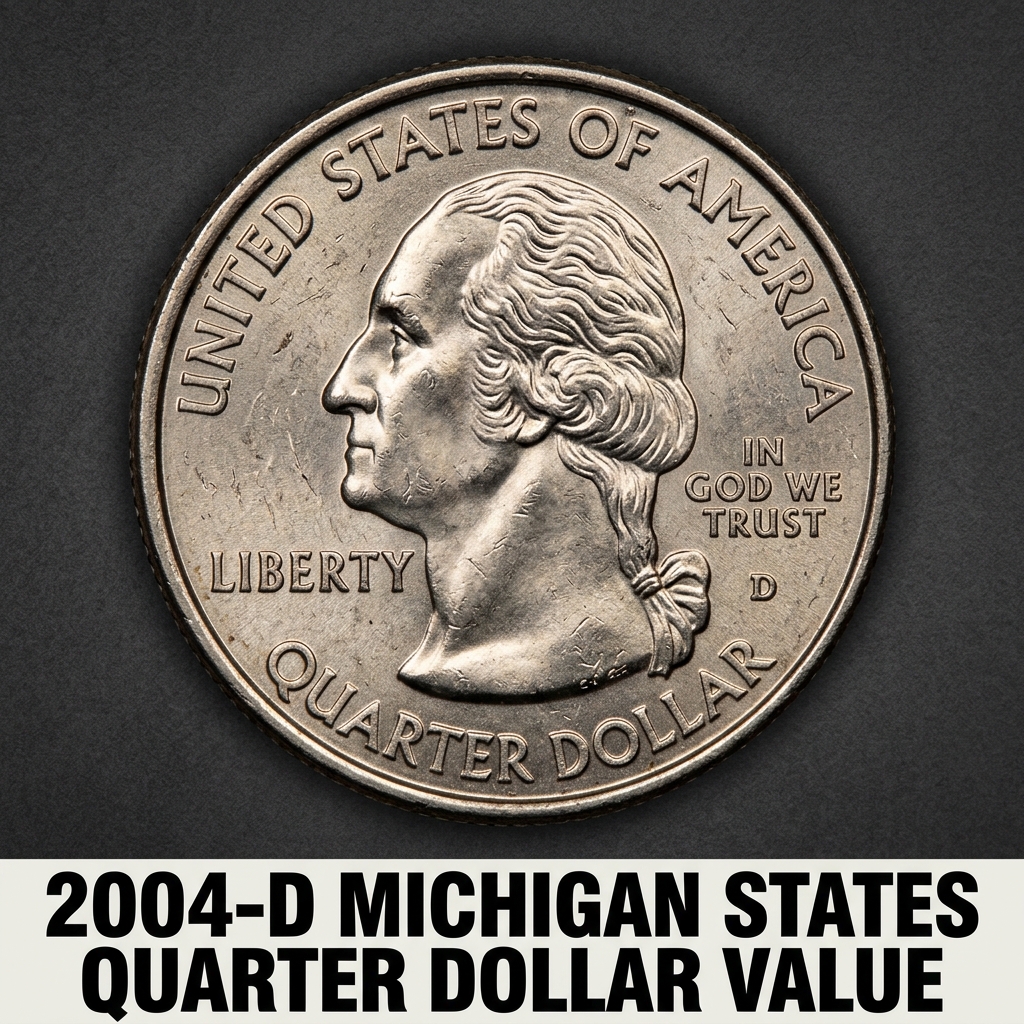
How Much Is a 2004 D Michigan State Quarter Worth Today
The 2004 D Michigan State Quarter is worth anywhere from its $0.25 face value in circulated condition to over $15 in high-grade mint state. While most of these coins you find in your pocket change are only worth twenty-five cents, certain pristine specimens and rare errors can fetch a much higher price.
Is Your 2004 Michigan Quarter Rare or Valuable
The 2004 Michigan quarter was the 26th coin released in the United States Mint’s popular 50 State Quarters Program. Struck at the Denver Mint—indicated by the “D” mint mark on the obverse—this coin honors “The Great Lakes State” with a design featuring the outline of the state and the Great Lakes system. If you have found one of these in your spare change, you might be curious if it’s a hidden treasure.
To get an instant answer, many collectors use a free coin identifier app to evaluate the condition and variety of their finds. When using the CoinKnow app, you can quickly determine if your coin is a common circulation strike or a high-grade specimen worth keeping. Generally, for a 2004-D Michigan quarter to be worth more than face value, it must be in “uncirculated” condition, meaning it hasn’t been worn down by being passed from person to person in daily commerce.
Factors That Determine the Michigan Quarter Value
The primary factor driving the price of a 2004-D quarter is its physical condition, also known as its “grade.” Coins are graded on a scale from 1 to 70. Most quarters you find in your wallet are heavily circulated and graded around “Good” or “Very Good.” These are worth exactly 25 cents. However, if you happen to find one that looks brand new with a sharp luster, it could be a “Mint State” (MS) coin.
According to current market data, the Michigan quarter value in Mint State 65 is approximately $1 to $2, while those in MS 67 can reach $15 or more. Professional collectors often look for coins that have no scratches or “bag marks” from when the coins were shaken together during transport. If you think you’ve found a particularly shiny one, the CoinKnow tool can help you compare your coin against professional grading standards.
A Quick Guide to 2004 Michigan Quarter Prices
To help you understand what your coin might be worth at a coin shop or online auction, we have compiled a price table based on the most common grades found by everyday hunters. Please remember that these prices are estimates and can fluctuate based on the current numismatic market demand.
| Condition / Grade | Estimated Value (USD) |
|---|---|
| Circulated (Good to About Uncirculated) | $0.25 (Face Value) |
| Uncirculated (MS 63) | $0.50 – $1.00 |
| Gem Uncirculated (MS 65) | $2.00 – $5.00 |
| High Grade (MS 67+) | $15.00 – $40.00+ |
Identifying Rare Errors and Varieties
While the standard “D” mint mark coins are common, some collectors specifically hunt for “errors.” These are mistakes made during the minting process that make a coin unique. For the Michigan quarter, collectors often look for “die cracks” or “doubled dies.” A doubled die error occurs when the hub imprints the image onto the die twice at slightly different angles, creating a blurry or doubled effect on the letters or the state outline.
When looking at the 2004 state quarter price trends for error coins, you may find that documented errors can sell for $20 to $100 depending on the severity of the mistake. Before you spend your quarters at the grocery store, take a second look. Using the CoinKnow mobile app allows you to zoom in on the details of your coin to spot these tiny imperfections that the naked eye might miss.
The Significance of the Michigan Quarter Design
The 2004 Michigan quarter design was selected through a statewide competition and finalized by Governor John Engler. It features an outline of the state of Michigan and the Great Lakes, along with the inscription “Great Lakes State.” This design celebrates Michigan’s unique geography as the only state consisting of two peninsulas connected by the Mackinac Bridge.
Because millions of these coins were minted in Denver (over 225 million, to be exact), they are not rare in the traditional sense. However, they remain a favorite for people building a complete “Statehood Quarters” map or album. Whether you are a resident of Michigan or just a curious collector across the country, knowing the history and value of the coins in your pocket adds a layer of excitement to your daily transactions.
Frequently Asked Questions about the 2004 D Michigan Quarter
Q: What does the “D” on my Michigan quarter mean?
A: The “D” stands for the Denver Mint, where the coin was strike. Quarters from this year were also produced in Philadelphia (P mint mark) and San Francisco (S mint mark for collector proof sets).
Q: Is there a silver version of the 2004 Michigan quarter?
A: Yes, the U.S. Mint produced silver proof versions in San Francisco. These will have an “S” mint mark and a much shinier, mirror-like finish. They are made of 90% silver and are worth significantly more than the standard copper-nickel “D” coins.
Q: Should I get my 2004 D Michigan quarter professionally graded?
A: Generally, it is only worth paying for professional grading if the coin is in near-perfect condition (MS 67 or higher) or if it has a verified, major error. For most circulated coins, the cost of grading will exceed the value of the coin itself.
