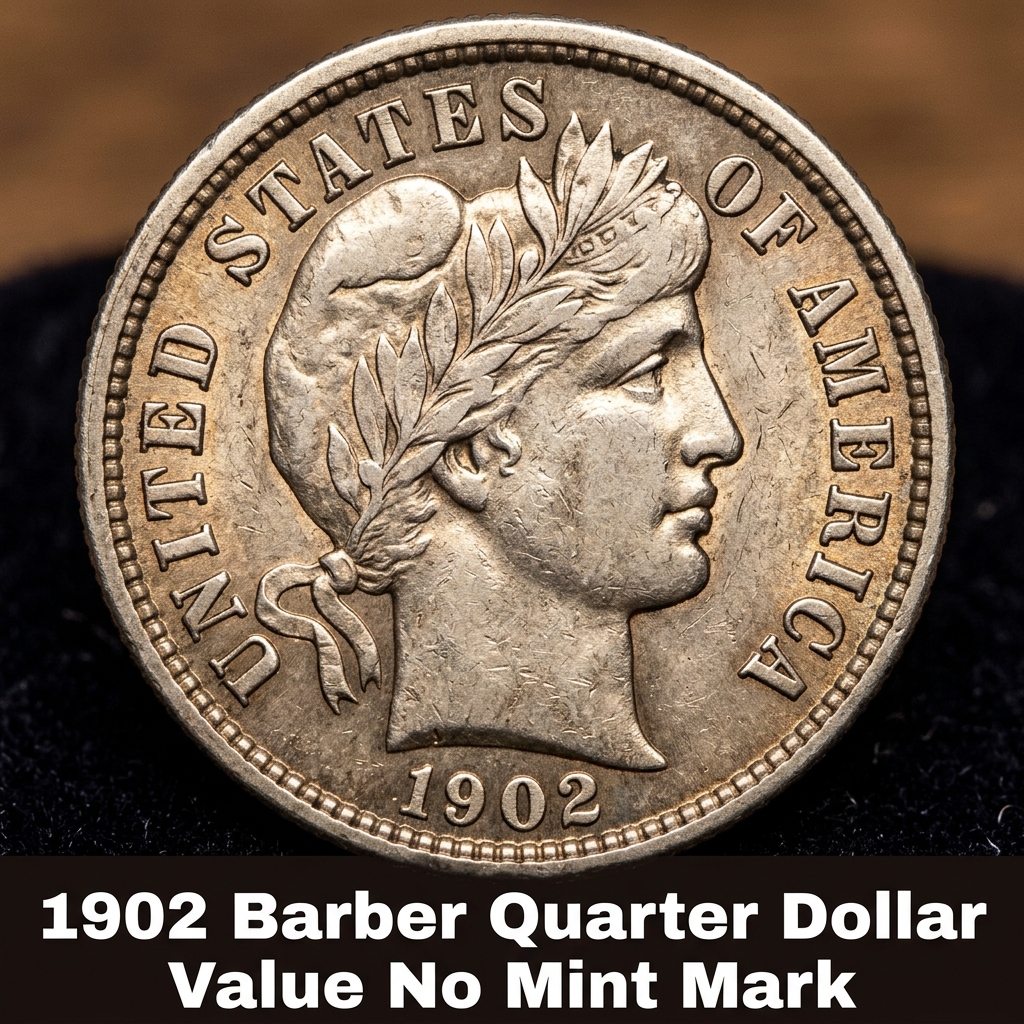
1902 Barber Quarter Dollar Value Guide and Price Chart for Coins with No Mint Mark
The 1902 Barber Quarter with no mint mark is worth anywhere from $8 in heavily worn condition to over $600 in high-grade uncirculated condition. If you just found one of these heavy silver coins in an old jar or a inherited collection, you might be holding a piece of American history that carries significant premium over its face value.
Understanding the 1902 Philadelphia Mint Barber Quarter
The 1902 Barber Quarter was designed by Charles E. Barber and features a stoic personification of Liberty wearing a Phrygian cap and a laurel wreath. To find the mint mark on a Barber Quarter, you would usually look on the reverse side, just below the eagle’s tail. If you do not see a letter there, it means your coin was struck at the main Philadelphia Mint. In 1902, the Philadelphia Mint produced over 12 million of these quarters, making them relatively common compared to some of the rarer dates in the series.
However, “common” is a relative term in the world of numismatics. Because these coins were used heavily in daily commerce at the turn of the century, most survivors are very worn. Finding one in late-19th or early-20th-century condition is a treat for any collector. If you are unsure about what you have, using a free coin identifier app can help you confirm the date and mint variety instantly. Many people also find it helpful to use the CoinKnow app to keep a digital inventory of their discoveries while they research the market.
How Grading Affects the 1902 Quarter Value
The single most important factor in determining the price of your 1902 Barber Quarter is its “grade,” or its state of preservation. Collectors use a 70-point scale to rank coins. Most coins found by everyday Americans fall into the “Good” to “Very Good” categories. In these grades, the word “LIBERTY” on the headband is usually worn away, and the eagle’s feathers on the back are smoothed out.
As the condition improves, the value climbs significantly. A “Fine” specimen will show at least three letters of “LIBERTY,” while an “Extremely Fine” coin will have sharp details in the hair and feathers. For those who enjoy collecting silver dollars as well, the 1902 Morgan silver dollar value often follows a similar trajectory based on luster and strike quality. Whether it is a quarter or a dollar, preserving the original surface is key; never clean your coins, as this destroys their numismatic value.
1902 Barber Quarter Price Comparison Chart
To give you a better idea of what your coin might be worth at a coin shop or online auction, refer to the table below. These prices represent average market retail for coins with no mint mark.
| Condition / Grade | Estimated Value (USD) |
|---|---|
| Good (G-4) | $8 – $12 |
| Very Good (VG-8) | $15 – $22 |
| Fine (F-12) | $35 – $45 |
| Very Fine (VF-20) | $65 – $85 |
| Extremely Fine (EF-40) | $125 – $150 |
| About Uncirculated (AU-50) | $210 – $260 |
| Uncirculated (MS-60+) | $375 – $650+ |
Silver Content and Melt Value for 1902 Quarters
Even if your coin is so worn that the date is barely visible, it still holds “intrinsic” value because of its metal content. All Barber Quarters minted in 1902 are made of 90% silver and 10% copper. When silver prices are high, even a “slick” or damaged coin can be worth several dollars just for the precious metal inside. Every quarter contains approximately 0.1808 troy ounces of pure silver.
For many casual hunters, using an app like CoinKnow allows you to track the live “melt value” of your silver coins based on the current market price of silver. This ensures you never sell a coin for less than its raw metal worth. While the collector (numismatic) value is usually higher for better-looking coins, the silver floor provides a safety net for your investment. It is part of what makes collecting these 100-year-old pieces so rewarding for regular families.
Identifying Rare Varieties and Errors
While the 1902 Philadelphia (No Mint Mark) issue is straightforward, collectors always keep an eye out for minor errors or exceptionally “proof-like” strikes. Proof coins were also struck in 1902 specifically for collectors, and these can be worth $800 to $1,500 because they feature mirror-like backgrounds and frosted details.
If you notice doubling on the letters or the date, you might have an error coin. Errors are rare in the Barber series but can fetch a significant premium from specialists. If you suspect your coin has a unique feature, you can upload a photo to CoinKnow to get a better sense of what to look for. Generally, a sharp, clean strike with no scratches or “hairlines” from cleaning will always bring the most money at auction.
Q: How can I tell if my 1902 Quarter has a mint mark?
A: Turn the coin to the back (reverse). Look at the space right above the “R” and “” in the word QUARTER and below the eagle’s tail feathers. If it is blank, it was made in Philadelphia. If there is an “S” or an “O,” it was made in San Francisco or New Orleans, respectively.
Q: Is it worth getting my 1902 Barber Quarter professionally graded?
A: Professional grading by services like PCGS or NGC is usually only worth the cost if your coin is in “Uncirculated” condition or is a rare variety. If the coin is heavily worn, the grading fees might cost more than the coin is worth.
Q: Why is my 1902 Quarter dark or black in color?
A: This is called toning. Silver reacts with sulfur in the air over many decades, creating a patina. If the toning is rainbow-colored or attractive, it can actually increase the value. Never try to clean this off with chemicals or polish.
